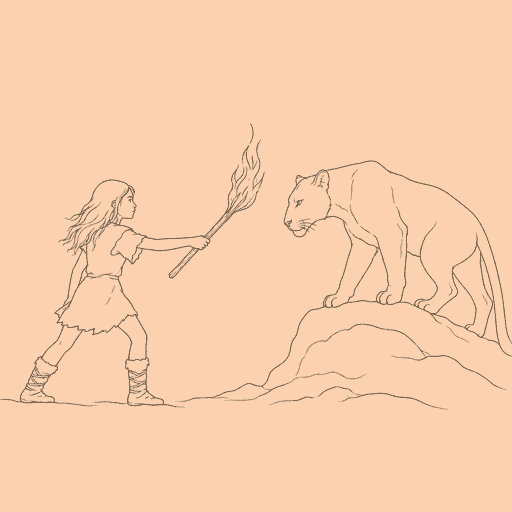
Maroo Of The Winter Caves
Maroo Of The Winter Caves
A modern alternative to SparkNotes and CliffsNotes, SuperSummary offers high-quality Study Guides with detailed chapter summaries and analysis of major themes, characters, and more.
Summaries & Analyses
Quizzes
NEWReading Tools
Chapters 5-8Chapter Summaries & Analyses
Content Warning: This section of the guide includes discussion of death.
Chapter 5 Summary: “A New Friend”
Maroo and Otak care for the wild pup they found, building it a small shelter. Old Mother cautions them against becoming too attached, advising them not to give the dog a name until it proves that it will follow them when they leave camp. The family enjoys the ease of summer; Vorka makes the children pipes and whistles, Areg makes a new drum, and they reconnect with another group led by a man named Sovi.
Over several days, the children gradually tame the pup. One morning, after being left untied overnight, the dog is waiting for Maroo by the fire. The two groups decide to travel together to the seashore so that Tikek will have additional help when her baby is born. As they pack up to leave the gorge, Maroo whistles for the dog. It immediately runs to join her on the trail. Seeing its loyalty, Old Mother gives the children permission to name it. They call him Rivo, a name that means “friend,” and the combined group heads east toward the seashore, with vast reindeer herds moving in the same direction across the plain.
Chapter 6 Summary: “The Sea”
The journey to the sea takes half a moon, with Vorka marking the days on a bone amulet. The group’s travel is slowed by the pregnant Tikek. When they reach the coast, Maroo sees the sea for the first time. Otak discovers a large cave, and they make a home in it on a sandy beach. The children are fascinated by the ocean and the seals that watch them from the water, which Areg calls the “Seal People.” The families subsist on food gathered from the shore, such as limpets.
After Maroo and Otak see Rivo swimming in a rock pool, they realize that he could be useful for hunting. Though initially skeptical, Areg agrees and shows them how to train the dog to sit and be quiet. As summer ends, the group grows anxious because they’re late to leave for their autumn hunting grounds. They can’t travel until Tikek has her baby. Then, Old Mother and Avni announce that Tikek has given birth and that the baby is alive.
Chapter 7 Summary: “The Ibex Hunt”
Because Tikek is still weak after childbirth, Sovi’s group leaves for the west first, with Areg’s family planning to follow. A few days later, Areg’s family sets out but takes a lower, easier path, causing them to lose sight of Sovi’s signal fire. They camp on a plateau near a large rock wall that produces an echo. Old Mother identifies it as the home of a “calling spirit” and is unnerved. Areg leaves an offering of fish to appease it.
The next morning, the fish is gone, and Areg concludes that the spirit took the form of a great cat. He and Vorka then discover fresh ibex tracks. Believing that the spirit may have sent the animals as a gift, Areg pushes for a hunt despite Old Mother’s warning that it’s too dangerous for only two men. However, Old Mother is tempted by the thought of meat and finally agrees. Areg and Vorka paint their faces for the hunt and head into the mountains. When they don’t return by the following morning, Old Mother, Maroo, Otak, and Rivo set out to search for them. Rivo follows the hunters’ trail to an injured Vorka trapped on a cliff ledge, and Maroo discovers Areg lying at the bottom of the cliff.
Chapter 8 Summary: “The Silent Drum”
Old Mother, Maroo, and Otak attempt to rescue the injured Vorka from the cliff ledge. Old Mother considers going down herself but accepts Maroo’s argument that she can’t make the climb safely, and Maroo descends to splint Vorka’s broken arm, allowing him to descend to the ground. Vorka explains that in the fading light, he and Areg fell while trying to drive ibex over the cliff. Vorka had sprung forward instinctively to try to save his brother as he went down.
After the family gathers, they perform a burial ritual, covering Areg’s body with a mound of stones. Tikek places his spear in the grave, Otak adds his harpoon, and Maroo reluctantly lays the new drum beside him after Vorka refuses it, saying that it won’t speak to him. Vorka, traumatized, sinks into a “sickness of the spirit” and refuses to eat (65). Tikek names her newborn son Areg in honor of his father. The family leaves the burial site and rejoins Sovi’s trail, but it’s now cold. Maroo realizes that with her father dead and Vorka injured, she must become the family’s hunter, with Rivo’s help.
Chapters 5-8 Analysis
The narrative arc of these chapters moves from a peaceful, communal summer to sudden tragedy, a structural shift that emphasizes how quickly the family’s circumstances can change. The family’s time at the seashore is characterized by ease and creativity: “Nobody work[s] hard in this season” as they enjoy abundant food, make musical instruments, and dance to a new drum (30). The tone is relaxed, and the pacing is slow, reflecting a period of safety and plenty. This tranquility is abruptly shattered when the family ventures into the mountains and camps on a plateau that “seem[s] unfriendly.” The setting shifts from the open seashore to a menacing landscape dominated by an echoing rock wall. This dramatic change in atmosphere and pacing highlights how quickly security can give way to danger within the family’s world. The move from the peaceful ocean to the ominous mountains mirrors their journey from security to loss and uncertainty.
The children’s taming of a wild pup introduces a key instance of Human Adaptability as the Key to Survival, illustrating how compassion can encourage new ways of living alongside animals. Old Mother’s initial caution against naming the dog—“Once you give him a name, his spirit will be in your keeping” (29)—shows that caring for the pup carries both practical and spiritual responsibility within the family’s beliefs. Although the adults are skeptical, the children’s persistent care demonstrates their growing attachment to the pup. Their idea to train Rivo for hunting, which Areg eventually supports, shows how the family gradually recognizes the dog’s value as a hunting companion. When Maroo whistles and the dog “bound[s] along the trail to join her” (33), his loyalty confirms the trust that has developed between them. This relationship later becomes an important source of support for the family’s survival, showing how cooperation and mutual trust help the family adapt to changing circumstances.
The family’s reliance on spiritual belief is explored as their understanding of the natural world becomes uncertain. At the seashore, Areg’s respectful naming of the seals as the “Seal People” reflects a worldview that recognizes a close relationship between humans, animals, and the natural world. Later, the encounter with the “calling spirit” on the plateau introduces a more unsettling dimension to these beliefs. The echo leads the family to interpret the place as spiritually significant, reinforcing their respect for unseen forces. The family’s response—leaving an offering of fish—demonstrates how Tradition as an Emotional Anchor shapes their response to uncertainty. When the offering disappears and ibex tracks are discovered nearby, Areg interprets these events as signs that the spirit has accepted the gift. His decision to hunt reflects the influence of those beliefs, although the tragic outcome leaves that interpretation unresolved. Rather than questioning the family’s traditions directly, the episode shows how deeply spiritual beliefs shape their interpretation of events and the decisions they make in uncertain circumstances.
Areg’s death marks an important stage in Maroo’s maturation, forcing her to confront greater responsibility. The narrative contrasts her earlier argument with Otak that feeding Rivo is “a girl’s job” with the life-or-death responsibility she assumes on the cliff face (28). When Old Mother concedes that she can’t make the perilous climb to Vorka, Maroo steps forward to take on a task that no one else can safely perform. Her careful descent to splint Vorka’s arm demonstrates her courage, practical judgment, and willingness to act despite the danger, reinforcing the theme of Coming of Age Through Shared Responsibility. She risks her own life to save her uncle, demonstrating the growing sense of responsibility that distinguishes her from the young girl introduced earlier in the novel. The final realization that she must now learn to hunt with Rivo extends this development, showing that her father’s death brings new responsibilities that she must gradually learn to fulfil.
Areg’s drum takes on a different meaning after his death. The drum is introduced during the easy summer days, when its completion prompts a celebration in which the family “dance[s] all one afternoon” (30). In this context, it represents the family’s shared enjoyment and togetherness. After Areg’s death, it becomes a reminder of the family’s loss. Vorka’s refusal to accept it, saying, “It will not speak to me” (64), shows the depth of his grief and his inability to take his brother’s place. Maroo’s decision to place the drum in Areg’s grave recognizes its close connection to her father and to the family’s life before his death. The burial of the drum reinforces the family’s sense of loss and marks the beginning of life without their primary hunter and leader.

Get in-depth, chapter-by-chapter summaries and analysis from our literary experts.
- Grasp challenging concepts with clear, comprehensive explanations
- Revisit key plot points and ideas without rereading the book
- Share impressive insights in classes and book clubs