Maroo Of The Winter Caves
Maroo Of The Winter Caves
A modern alternative to SparkNotes and CliffsNotes, SuperSummary offers high-quality Study Guides with detailed chapter summaries and analysis of major themes, characters, and more.
Summaries & Analyses
Quizzes
NEWReading Tools
Important Quotes
Content Warning: This section of the guide includes discussion of death and animal death.
“Maroo woke hungry. She lay for a moment with her eyes shut, imagining biting into tough, hot meat, savoring the charred, smoke-tasting outer part and then the salty blood within.”
(Chapter 1, Page 1)
The novel begins by showing how closely everyday life is tied to the search for food. Maroo’s thoughts reveal that meat has been scarce for some time, making the hunters’ return essential to her family’s survival. This opening immediately introduces the difficult conditions in which the family lives.
“The small drum was made of hide stretched over bone and decorated with fox-fur pompoms on thongs that spun outward as Areg tossed and caught the drum and tapped a complex rhythm.”
(Chapter 2, Page 10)
Areg plays the drum during the celebration after the successful bison hunt. The music brings the group together as they clap, sing, and enjoy the feast, showing that shared traditions remain important even in a life shaped by constant challenges.
“And yet she knew it was not the thought of the lions that gave her that strange feeling whenever the tribe passed the White Mountain: It was the spirits.”
(Chapter 2, Page 13)
Although the White Mountain is known for real dangers such as cave lions and glaciers, Maroo fears the spirits even more because she doesn’t understand them. The quotation shows how deeply the tribe’s beliefs shape the way they view the world and explains why the mountain is treated with such caution.
“After all, what use was a dog? Dogs were rivals of people, and a sick one would take precious food.”
(Chapter 4, Page 21)
Maroo understands why the adults hesitate to keep the injured pup. Food is scarce, and every member of the group must contribute to the family’s survival. This quotation explains why caring for the pup requires the children to place compassion above immediate practical concerns.
“Maroo was pleased; she loved these stories because her own name meant ‘Little Ptarmigan.’”
(Chapter 4, Page 27)
Maroo's enjoyment of Old Mother’s stories is strengthened by her connection to the clever bird-goddess whose name she shares. The quotation shows how stories form part of the family’s daily life and preserve the beliefs that are passed from one generation to the next.
“The dog stood barking by the empty hearth-place. This was the moment for which Maroo had been holding herself in readiness. She was trembling as she set off along the trail and turned to whistle to the dog. The dog stiffened at the sound, and his ears pricked up. Then, without hesitating, he bounded along the trail to join her.”
(Chapter 5, Page 33)
Old Mother leaves the decision to the pup, allowing it to choose whether to remain behind or follow the family. The dog’s immediate response to Maroo’s whistle marks the beginning of their lasting bond and confirms that it has accepted its place among them.
“They came to a gap between two hills, and, looking down, instead of the expected green plain they saw a gray expanse of water that stretched forever.”
(Chapter 6, Page 36)
The family has reached the sea for the first time after traveling across the plain. Maroo has often imagined seeing the sea, but its vast size is beyond anything she expected. The quotation captures her first impression of a place she has long wanted to visit.
“Areg came and squatted beside the children. ‘They are the Seal People,’ he said. ‘Call them a greeting.’”
(Chapter 6, Page 38)
Areg teaches the children how to respond to unfamiliar animals they encounter during their journey. Calling the seals “Seal People” reflects the family’s beliefs and encourages the children to show respect for the living world around them.
“Areg clapped loudly and experimentally: clap, clap, clap. Back came the answer from the rock wall: clap, clap, clap. There was silence. Maroo felt her hair lifting; she could smell fear; even Old Mother was afraid.”
(Chapter 7, Page 47)
The echo from the rock wall frightens the family because they believe it comes from a calling spirit. Their reaction shows how strongly their spiritual beliefs influence the way they understand unfamiliar places and experiences.
“The man was Areg and yet not only Areg; he had become an ibex.”
(Chapter 7, Page 52)
Areg’s appearance after the hunting ritual reflects the family’s belief that successful hunting depends on more than skill alone. By taking on the identity of the ibex, he prepares himself spiritually as well as physically for the hunt. The quotation reflects the novel’s theme of Tradition as an Emotional Anchor, showing how shared beliefs guide the family’s actions and strengthen their confidence.
“‘He will die,’ Tikek said desperately to Old Mother, but Old Mother said, ‘It is a sickness of the spirit. It will pass. Tomorrow we must be back on the trail.’”
(Chapter 8, Page 65)
Old Mother recognizes Vorka’s grief over Areg’s death but also understands that the family can’t delay their journey. Her decision reflects the difficult choices required to keep everyone safe as winter approaches. The quotation shows how experience, resilience, and shared beliefs help the family endure loss while continuing to move forward.
“It was then that she realized, with a shock, that they had no hunter, only a boy and a wounded man whose spirit was sick. I shall have to hunt, she thought, and Rivo—yes, Rivo will help us.”
(Chapter 8, Page 67)
Maroo realizes that her family can no longer depend on the adults to provide food. She accepts the responsibility of becoming their hunter and immediately begins thinking of practical ways to help them survive. The quotation reflects the novel’s theme of Coming of Age Through Shared Responsibility, as Maroo places her family’s needs above her own uncertainty.
“It was as if winter were a giant striding behind them, his shadow already looming.”
(Chapter 9, Page 69)
Winter is approaching quickly, and the family knows they have little time to reach the autumn camp before the weather becomes too dangerous. The quotation conveys the constant pressure created by the changing seasons and reflects the novel’s theme of Human Adaptability as the Key to Survival, as the family must continually adjust their plans to stay ahead of the approaching winter.
“To survive one must be ruthless, or risk the loss of many more people.”
(Chapter 9, Page 69)
Maroo begins to understand that survival sometimes requires difficult decisions for the sake of the whole family. Although the thought is painful, she recognizes that protecting the group may require personal sacrifice. The quotation reflects the novel’s theme of Coming of Age Through Shared Responsibility, as Maroo starts to think like a leader instead of a child.
“When the round shape was finished, they built an entrance tunnel with a bend in it to keep out drafts. Then they crawled in, one after the other, and Old Mother made new fire.”
(Chapter 10, Page 80)
The snow house demonstrates the family’s practical knowledge of living in a harsh environment. Every part of its design helps protect them from the cold, allowing them to survive the blizzard safely. The quotation reflects the novel’s theme of Human Adaptability as the Key to Survival, showing how experience and shared knowledge help the family overcome changing conditions.
“If one of you is injured or lost, the other must leave him or her and go on alone. One must survive.”
(Chapter 10, Page 87)
Old Mother gives this instruction before Maroo and Otak set out across the White Mountain in search of help. She knows that the family’s survival depends on one of them reaching the winter camp, even if the journey becomes more difficult than expected. The quotation reflects the novel’s theme of Coming of Age Through Shared Responsibility, as Maroo is entrusted with a responsibility far greater than her years.
“A man might have a sharp spear and a full belly, but if he has lost hope, he will die.”
(Chapter 11, Page 91)
Old Mother explains why stories matter as much as food and shelter during difficult times. She believes that hope gives people the strength to keep going when they face hardship and uncertainty. The quotation reflects the novel’s theme of Tradition as an Emotional Anchor, showing how stories help the family endure fear and loss.
“Maroo watched it lovingly; it was her first hearth-place.”
(Chapter 11, Page 95)
Maroo takes pride in building and tending her own fire during the journey across the White Mountain. The small hearth reflects the growing confidence and responsibility she develops as she cares for herself and Otak away from the rest of the family. The quotation also reflects the novel’s theme of Coming of Age Through Shared Responsibility, as Maroo gradually grows into the role that Old Mother has entrusted to her.
“But Old Mother had said that the mountain was guarded by spirits, and Areg had been killed hunting an ibex.”
(Chapter 12, Page 102)
As Maroo and Otak continue across the White Mountain, they remember both Old Mother’s warning and their father’s death. The quotation shows how these memories shape the way the children understand the dangers around them. It also reflects the novel’s theme of Tradition as an Emotional Anchor, as Old Mother’s teachings continue to guide them even in her absence.
“They both remembered Old Mother’s words about the mountain, how it was dangerous and they should cross it quickly ‘before it feels that you are there.’ And now they were trapped here by the blizzard, and surely the mountain spirits must know it.”
(Chapter 13, Page 109)
The blizzard prevents Maroo and Otak from following Old Mother’s advice to cross the mountain quickly. Believing that the mountain spirits are aware of their presence adds to their fear and uncertainty as they wait for the storm to pass. The quotation reflects the novel’s theme of Tradition as an Emotional Anchor, showing how the children’s beliefs influence the way they respond to danger.
“‘You’re just a baby!’ she said. ‘You can’t catch anything yourself, and now you are angry because I can!’”
(Chapter 14, Page 120)
Maroo’s angry words come after she successfully catches a hare while Otak has caught nothing. The argument leaves Otak determined to prove that he can hunt on his own, leading him to leave the shelter despite the dangers of the mountain. This moment becomes a turning point in the children’s journey and the challenges they must face separately.
“She remembered Old Mother’s warning: There must be no risks taken; if one of them was lost or injured, the other must go on. One must survive.”
(Chapter 15, Page 123)
Maroo remembers Old Mother’s instruction after she discovers that Otak has disappeared. Although she wants to keep searching for her brother, she knows that the rest of her family is waiting for help. The quotation reflects the novel’s theme of Coming of Age Through Shared Responsibility, as Maroo accepts the difficult responsibility that Old Mother entrusted to her.
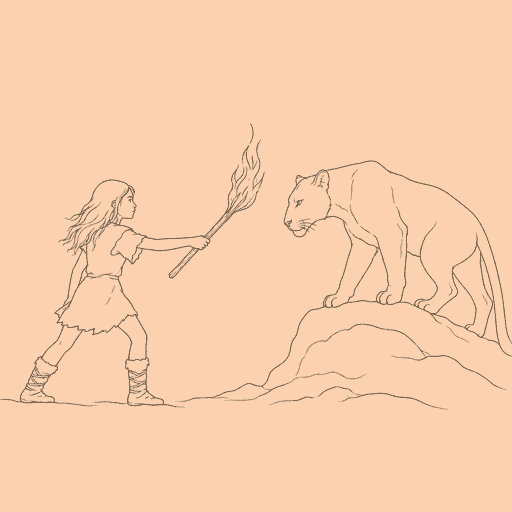
“Maroo knew for certain that this was the mountain spirit. The silvery lion was the mountain itself, come to bar her way, challenging her for being so bold as to think she could trespass on it.”
(Chapter 15, Page 129)
Maroo believes that the cave lion is the spirit of the White Mountain confronting her as she continues her journey. Her understanding of the encounter reflects the beliefs she has learned from Old Mother and shapes the way she responds to the danger before her. The quotation reflects the novel’s theme of Tradition as an Emotional Anchor, showing how those beliefs continue to guide her during one of the most frightening moments of her journey.
“Maroo became aware that songs were being sung in her honor; she would always be remembered now throughout the four tribes as the girl who had crossed the White Mountain and survived.”
(Chapter 16, Page 134)
Maroo’s successful journey across the White Mountain is recognized by all four tribes, and her courage becomes part of the stories they share. The songs celebrate her achievement and ensure that her actions will be remembered by future generations. They also show how important storytelling is to the community, preserving significant events and passing them on to future generations.
“He’s a good dog. I would have died without him.”
(Chapter 16, Page 136)
Otak acknowledges that Rivo kept him alive after he became lost on the mountain by helping him find food, warmth, and the way to the camp. His words confirm the importance of the bond that developed after Maroo and Otak rescued the injured pup. The quotation reflects the novel’s theme of Human Adaptability as the Key to Survival, showing how the family’s decision to care for Rivo ultimately helps save a life.

Unlock every key quote and its meaning
Get 25 quotes with page numbers and clear analysis to help you reference, write, and discuss with confidence.
- Cite quotes accurately with exact page numbers
- Understand what each quote really means
- Strengthen your analysis in essays or discussions