Maroo Of The Winter Caves
Maroo Of The Winter Caves
A modern alternative to SparkNotes and CliffsNotes, SuperSummary offers high-quality Study Guides with detailed chapter summaries and analysis of major themes, characters, and more.
Summaries & Analyses
Quizzes
NEWReading Tools
Chapters 9-12Chapter Summaries & Analyses
Content Warning: This section of the guide includes discussion of animal death.
Chapter 9 Summary: “No Smoke”
As the family continues to follow Sovi’s trail, they find that the signs are growing older, indicating that they’re falling farther behind, and they realize that they’re unlikely to catch up to his group until they reach the autumn hunting grounds. Their progress is slow due to Vorka’s arm injury, Tikek’s exhaustion from caring for her new baby, and the needs of Nimai. Although Vorka gradually recovers his spirits and begins eating and talking again, he’s too injured to hunt the deer that migrate across the plain, and the family subsists on mushrooms and small animals caught by Otak and Rivo. After witnessing a pack of wild dogs kill a deer, Otak regrets that they didn’t use fire to drive the dogs away and claim the meat.
The weather turns colder, and the first snows arrive. Otak successfully hunts a ptarmigan with his sling, providing a welcome meal. Old Mother notices that Otak’s toe is nearly frostbitten and treats it, warning him of the danger. Soon after, a severe blizzard begins. Old Mother insists that they must keep moving and leads them on an exhausting march toward a familiar outcrop of rocks that can provide shelter. After a miserable night, she explains that their food supplies are too low and that they can’t hunt in the storm, so waiting immediately could leave them to starve before the blizzard ends. Following another brutal day of walking, Old Mother finally declares that they can go no further and must stop to build a snow house.
Chapter 10 Summary: “Old Mother’s Decision”
The family builds a domed snow house and shelters inside for two days while the blizzard continues. Their food runs out completely, and they grow weak from hunger. On the third day, the storm breaks, and they see the White Mountain in the distance. Old Mother, however, declares that winter has overtaken them and that they’re too late to take the long, safe trail around the mountain.
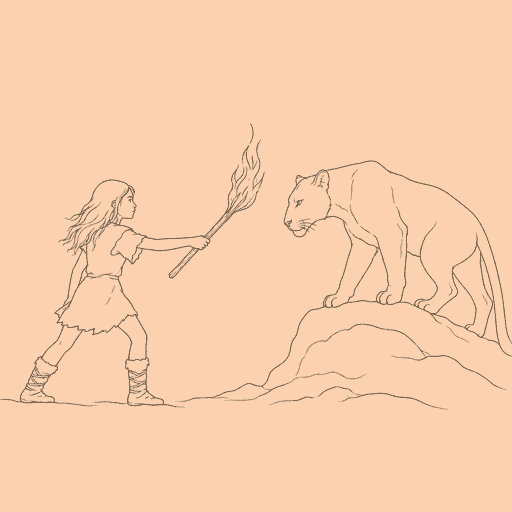
Just then, they hear wild dogs attacking a deer nearby. Remembering their earlier idea, Maroo and Otak grab flaming torches, run to the kill site, and successfully drive the pack away from the carcass. They secure an essential supply of meat for the family. Old Mother praises the children, telling them that they have saved everyone’s lives. That evening, after they have eaten, Old Mother announces a new, desperate plan: Because the family’s meat won’t last long and the route around the White Mountain will lead to starvation, Maroo and Otak must travel alone over the White Mountain via a dangerous and forgotten trail to get help. Vorka protests, insisting that he should go, but Old Mother asserts that his arm is too weak to hunt reliably and that he’s needed to protect the family. Tikek is horrified at the thought of risking her children, but Old Mother is firm, explaining that it’s their only chance. She gives the children a final, solemn command: If one of them is injured or lost, the other must continue on alone to complete the mission.
Chapter 11 Summary: “The White Mountain
Old Mother instructs Maroo and Otak on how to find the trail across the White Mountain, which involves crossing a glacier and passing through the treacherous Pass of the Spirits. She officially appoints Maroo as the leader, explaining that she trusts her to be sensible and cautious, and she tells Otak that he must obey her. They are to take Rivo for help with hunting but are also warned that they must be prepared to kill and eat him if they face starvation. Before they leave, Old Mother reminds them that stories give people hope during the hardest times.
Given only a small portion of the deer meat and a smoldering ember from the hearth fire, the children say goodbye to their family. They travel all day toward the mountain, reaching its lower slopes by late afternoon. They climb to a plateau that Old Mother described and make their first camp. From this high vantage point, Maroo can see the tiny column of smoke rising from her family’s snow house far below on the plain, a sight that makes her feel acutely lonely and afraid. As they lie awake that night, the children talk to distract themselves from their fears, discussing the secret initiation rites for becoming a hunter.
Chapter 12 Summary: “The Glacier”
The next morning, Maroo leads the way across the glacier, carefully using her staff to test the snow for hidden crevasses. Otak follows her footsteps and reluctantly obeys her command not to hunt. As they near the pass, the snow under Maroo’s feet suddenly gives way, and she plummets into a crevasse, where she’s buried by an avalanche of snow and ice.
Trapped and struggling to breathe, Maroo manages to dig her upper body free and eventually frees herself enough to reach the rope after she sees Otak looking down from the edge and lowering it to her. Maroo ties it around her waist. Otak drives his staff deep into the snow to use it as an anchor for the rope, and with this support, Maroo is able to climb up the wall of the crevasse and pull herself out. She lies on the ice, shaken, while Rivo licks her face. As the children recover, they see a large buck ibex standing on the pass above, watching them silently before it disappears. Otak is frightened, wondering if it was a spirit, but Maroo pushes the thought aside and insists that they must keep moving.
Chapters 9-12 Analysis
The family’s construction of a snow house demonstrates Human Adaptability as the Key to Survival by showing how practical knowledge allows them to respond to worsening conditions. Faced with a blizzard that makes travel impossible, they use the surrounding snow to create shelter. Their practiced construction of a “low domed house” from carefully shaped blocks demonstrates the survival knowledge they possess and can apply in an emergency (80). This resourcefulness also appears in the children’s response to the wild dogs. Their earlier observation that fire could drive the animals away prepares for the later scene in which Maroo and Otak use burning torches to claim a deer carcass. Turnbull uses this earlier missed opportunity as foreshadowing, allowing the children to apply what they have learned when the family urgently needs food. Their ability to secure an essential food source through coordinated action highlights how observation, cooperation, and learned skills help the family survive hunger and severe weather.
Old Mother’s solemn decision to send the children over the mountain alone marks an important stage in their growing responsibility within the family. When she declares, “Maroo and Otak must go alone and fetch help […] or we shall all die” (86), she places the fate of the entire family in their hands. This moment reinforces the theme of Coming of Age Through Shared Responsibility. The weight of this new role is amplified by her stark command that “if one of [them] is injured or lost, the other must leave him or her and go on alone” (87). This difficult instruction reflects Old Mother's determination to give the family its best chance of survival, requiring the children to place the family’s needs above their own feelings. Tikek’s horrified reaction and Vorka’s protests underscore the magnitude of the sacrifice being asked. Old Mother’s choice is based on the family's immediate circumstances: Vorka’s injured arm prevents him from hunting effectively, and he’s needed to protect the family, so Maroo and Otak are the only ones capable of making the journey. The mission therefore marks the beginning of a new level of responsibility for the children as they take on a role that had previously belonged to the adults.
The mission immediately tests the relationship between Maroo and Otak. Old Mother’s appointment of Maroo as leader reflects her confidence in Maroo’s judgment and caution, but it also creates tension, evident in Otak’s initial sulkiness. His reluctant obedience on the glacier, when Maroo forbids him from hunting, shows his struggle to accept her authority. The crisis in the crevasse demonstrates that the success of their journey depends on both children. When Maroo falls, Otak plays a crucial role in her rescue. His quick thinking—using his staff as an anchor to secure the rope—demonstrates his resourcefulness and reinforces the importance of cooperation during the journey. By rescuing Maroo, he shows that leadership doesn’t lessen the need for mutual support. The rescue strengthens the children’s trust in one another while also demonstrating that each contributes different strengths to the mission. Their survival depends on their ability to work together, confirming Old Mother’s judgment that they could undertake the journey together.
As the children embark on their journey away from their family, the narrative explores how belief and ritual help them face uncertainty, showing the theme of Tradition as an Emotional Anchor. Maroo carries a smoldering ember from the family hearth, which she believes is “good magic” and which helps her feel connected to home. The ember reflects the continuing importance of fire as a practical necessity while also reminding Maroo of the family’s “hearth-place.” Alone on the mountain, the children interpret unfamiliar places through the spiritual beliefs they have learned from their elders. To steady themselves, they talk about secret hunter initiations involving “bulls and horses and the secret pictures in the deep caves” (97). This reliance on the tribe’s cultural lore—its mysteries, songs, and traditions—helps them remain connected to their shared beliefs and family despite their physical separation.
The crossing of the glacier presents the children with one of the most dangerous stages of their journey. Maroo’s fall into the crevasse demonstrates the hidden dangers of the mountain even though she follows Old Mother’s instructions carefully. Her survival depends on both her determination and Otak’s quick thinking as he uses his staff to anchor the rope. The appearance of the buck ibex on the pass reinforces the uncertainty that surrounds the mountain. Otak’s fearful question, “Was it a spirit?” (103), reflects the spiritual beliefs through which the children interpret unfamiliar experiences. Turnbull leaves the ibex’s significance deliberately ambiguous, allowing it to be understood either as an ordinary animal or as something more meaningful within the children’s worldview. Maroo’s insistence that they press onward, despite the unnerving encounter, marks her growth as a leader who remains focused on the journey despite fear and uncertainty.

Get in-depth, chapter-by-chapter summaries and analysis from our literary experts.
- Grasp challenging concepts with clear, comprehensive explanations
- Revisit key plot points and ideas without rereading the book
- Share impressive insights in classes and book clubs