Maroo Of The Winter Caves
Maroo Of The Winter Caves
A modern alternative to SparkNotes and CliffsNotes, SuperSummary offers high-quality Study Guides with detailed chapter summaries and analysis of major themes, characters, and more.
Summaries & Analyses
Quizzes
NEWReading Tools
Themes
Content Warning: This section of the guide includes discussion of death.
Coming of Age Through Shared Responsibility
In Ann Turnbull’s Maroo of the Winter Caves, maturity develops through accepting increasing responsibility for the well-being of others. The novel frames coming of age as a process of accepting difficult responsibilities and making personal sacrifices for the survival of one’s family. Maroo’s transformation into a leader is defined by her acceptance of responsibility for her family’s survival, which requires her to prioritize the collective good over her own fears and personal attachments. Her journey, and to a lesser extent Otak’s, demonstrates that true maturity lies in understanding one’s role within a community and fulfilling the responsibilities that come with it, even when doing so requires personal sacrifice.
Maroo’s transition from childhood to adulthood begins when Old Mother chooses her and Otak for the perilous journey across the White Mountain. Maroo doesn’t volunteer for this role; she accepts the responsibility entrusted to her. By appointing Maroo as the leader, Old Mother formally places the family’s fate in her hands, stating, “Maroo is your leader; you must obey her” (90). Old Mother’s decision reflects her confidence in Maroo’s cautious and sensible nature, while also marking the moment when Maroo assumes responsibilities beyond those of childhood. Suddenly, Maroo is responsible for the lives of her mother, grandmother, brother, and new baby brother. This new responsibility shapes her maturation, requiring her to adopt an adult’s perspective on survival.
The most difficult test of Maroo’s newfound maturity comes when she must decide whether to continue toward the camp after Otak disappears in the blizzard. This moment illustrates the novel’s understanding of adulthood as accepting responsibility even when every option involves loss. Faced with her brother’s disappearance, her first instinct is to search, yet she remembers Old Mother’s instruction that if one of them is lost, the other must go on alone so that one might survive to get help. Her decision to continue the journey without searching further for Otak requires her to set aside her immediate desire to find her brother in order to fulfill her responsibility to the rest of the family. Although she continues the journey, she weeps and later prays to her father’s spirit to keep Otak safe. This act demonstrates her acceptance of the difficult responsibility entrusted to her, marking her growth into a leader who places the family’s survival above her own wishes.
Maroo’s journey emphasizes leadership, whereas Otak’s highlights self-reliance. He, too, is forced to mature, though his journey is more solitary. After quarreling with Maroo, he sets off alone, driven by wounded pride and a desire to prove himself. However, when he’s lost and injured, his focus shifts from proving himself to simply surviving. He and Rivo work together to find food, and their companionship develops into a partnership that becomes essential to their survival. When Otak returns to the camp, his experience demonstrates that maturity comes through resourcefulness and resilience rather than success as a hunter. His maturation complements Maroo’s, proving that responsibility can also mean taking care of oneself so as not to be a burden on the family.
Human Adaptability as the Key to Survival
In Maroo of the Winter Caves, survival depends on the ability to adapt to changing circumstances through practical knowledge, resourcefulness, and cooperation. Throughout their journey, Maroo and her family respond to environmental challenges by applying learned skills, from constructing shelters suited to different conditions to taming a wild pup and using fire to protect themselves. Through these experiences, the novel shows that people survive by adapting their knowledge and skills to changing circumstances.
The family’s capacity to build different types of shelters demonstrates how practical knowledge is applied to different environmental conditions. During their summer travels, the men construct a low, domed hut from willow branches, a lightweight and easily assembled structure suited to their nomadic lifestyle. Later, they build a snow house when a blizzard threatens their lives on the Great Plain. Designed with a curved entrance tunnel to block drafts and walls that insulate against the cold, the shelter reflects knowledge developed through experience and adapted to harsh winter conditions. The family works together quickly and efficiently to build it, showing that these survival skills have been passed down and practiced over generations. These structures demonstrate how applying knowledge to different environments enables the family to survive changing conditions.
The taming of the wild pup, Rivo, illustrates the family’s ability to adapt by finding new ways to survive. Initially, the adults are skeptical, viewing a dog as another mouth to feed. However, Maroo and Otak see potential, and their patient efforts to train him gradually earn his trust. Rivo becomes an important part of the family’s survival, helping to hunt small game when food is scarce and Vorka is injured. Ultimately, Rivo’s loyalty and hunting skills help keep Otak alive after he becomes lost on the mountain. Rivo becomes a trusted companion whose partnership reflects the family’s willingness to adapt to new possibilities for survival.
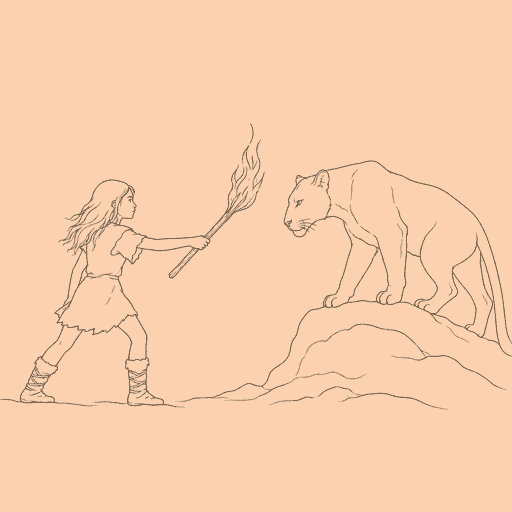
Maroo’s encounter with the cave lion on the White Mountain further demonstrates how practical knowledge and adaptability enable survival. Faced with a creature far larger and stronger than herself, she responds by using the resources and skills available to her. Reaching for her tools, she takes a torch coated with pitch and ignites it using the embers she has carefully carried from Old Mother’s fire. “Pitch and fire united,” the text notes, “The torch blazed, crackling and spitting, a red intruder in the silver night” (129). By combining fire with a prepared torch, Maroo creates a powerful deterrent that drives the lion away. This scene illustrates how the family’s survival depends on applying learned skills and adapting to unexpected dangers.
Tradition as an Emotional Anchor
In Maroo of the Winter Caves, the family’s stories, spiritual beliefs, and rituals help them face hardship, uncertainty, and loss. These traditions reinforce the family’s shared beliefs, give meaning to difficult experiences, and encourage them to keep going when they are afraid or grieving. Together, they show that hope, shared beliefs, and family traditions help the family endure the hardships they face.
Storytelling gives the family comfort and helps preserve their shared traditions during difficult times. When the family huddles together, Old Mother’s tales of the gods, such as the clever Ptarmigan, reinforce the beliefs and traditions they share. Maroo takes particular pleasure in these stories, as she’s named for the clever bird-goddess. Later, when trapped by a blizzard on the mountain, Maroo remembers Old Mother’s advice that “stories give you hope, even when the worst comes” and tells Otak a story (91). This act shows that the stories passed down through the family continue to offer comfort and hope, even when Old Mother is no longer there to tell them herself.
Rituals and beliefs about the spirit world help guide the family’s response to unfamiliar and dangerous situations. When they camp near a rock face that echoes their voices, Old Mother identifies it as the home of a “calling spirit” and tells the family they should leave it a gift. Areg places two fish within a ring of pebbles before they continue their journey. Similarly, after Maroo falls into a crevasse on the glacier, she tosses her precious shells into the chasm as an offering to the mountain spirits. These acts reflect the family’s belief that showing respect to the spirit world is an important part of traveling safely during their journey.
The importance of tradition is especially clear after Areg’s death. The family’s burial rites give them a shared way to honor him before continuing their journey. The women paint their faces black for mourning, and Old Mother paints Areg’s face with magic signs to guide him in the spirit world. They place his spear and drum in the grave before covering his body with heavy stones to prevent his spirit from walking. These burial customs reflect the family’s beliefs about death and the spirit world, helping them honor Areg while preparing to continue without him.

Unlock every key theme and why it matters
Get in-depth breakdowns of the book’s main ideas and how they connect and evolve.
- Explore how themes develop throughout the text
- Connect themes to characters, events, and symbols
- Support essays and discussions with thematic evidence