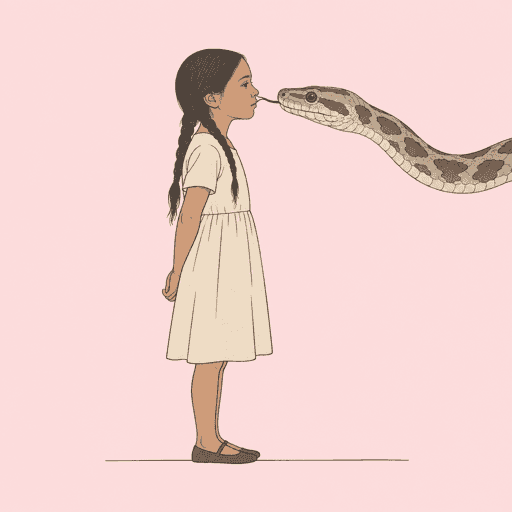
Python's Kiss
A modern alternative to SparkNotes and CliffsNotes, SuperSummary offers high-quality Study Guides with detailed chapter summaries and analysis of major themes, characters, and more.
Summaries & Analyses
Quizzes
NEWReading Tools
Background
Content Warning: This section of the guide includes discussion of child death, mental illness, and emotional abuse.
Geographical and Historical Context: The Great March Blizzard of 1923
The harrowing ordeal in “The Hollow Children” is grounded in the reality of sudden, lethal blizzards that have long plagued the Great Plains. Due to its unobstructed terrain, where trees and other geographical features are sparse, the Great Plains and the upper Midwest are especially vulnerable to winter storms and blizzards compared to most other regions of the United States. The story’s description of a storm starting on a “misty and mild April morning” before a 60-mile-per-hour wind drops the temperature below -20°F mirrors actual historic weather events (47). A particularly destructive blizzard struck North and South Dakota in early April 1923. Similar to the story, it was preceded by mild weather that caught many people unprepared. Temperatures plunged rapidly as winds reportedly gusted over 60 miles per hour, creating blinding whiteout conditions. Tragically, these storms often proved fatal for those caught outdoors, with historical accounts documenting the deaths of schoolchildren who were unable to make it home. One of the most famous examples is the Schoolhouse Blizzard of 1888, where hundreds of people, many of them children, died after a warm day suddenly turned into a catastrophic blizzard.
This historical context heightens the stakes of Ivek’s journey in “The Hollow Children,” transforming his struggle to save the children on his bus into a realistic depiction of the life-or-death situations faced by inhabitants of the region. These stakes gain added significance due to the story’s frame, which views Ivek’s struggle through the lens of community mythology. The story’s focus on the psychological terror and the desperate fight for survival reflects a grim, recurring chapter in the area’s history.
Historical Context: Buffalo Soldiers in the Department of Dakota
The backstory of Mr. Ponath in “Amelia,” whose “Black great-grandfather had come to the area around 1870 to garrison at the Dakota reservation” (192), is rooted in the significant yet often overlooked history of African American soldiers on the American frontier. Following the Civil War, the US Army formed several all-Black regiments, who came to be known as Buffalo Soldiers. In 1880, the 25th Infantry Regiment, one of these units, was transferred to the Department of Dakota. Companies of the 25th were stationed at posts including Fort Randall and Fort Hale in present-day South Dakota and Fort Buford in North Dakota. Their duties involved protecting settlers and railroad crews, building roads and telegraph lines, and generally maintaining peace in the region.
While the story’s timeline is approximate, the presence of the 25th Infantry in the Dakota Territory from 1880 onward provides a historically accurate foundation for the establishment of a multi-generational Black family in the area. This context enriches the narrative by grounding Mr. Ponath’s lineage in a specific, verifiable chapter of regional history. It highlights the diverse fabric of the American West and gives his character’s presence in the predominantly white town a deeper, more resonant historical significance, connecting him to a legacy of Black contribution to the settlement and development of the northern plains.
Cultural Context: Active Shooter Drills and Gen Z Anxiety
The mock-assassination game in “Assassin” directly reflects the lived experience of American students who have grown up in the shadow of school shootings. Since the 1999 Columbine High School massacre, active shooter and lockdown drills have become a routine part of school life; by the 2015-2016 school year, they were practiced in approximately “95 percent of American K-12 schools” (“The Impact of Active Shooter Drills in Schools.” Everytown for Gun Safety, 14 May 2024).
While intended to prepare students, these drills have been linked to significant psychological distress. Research has shown that such drills are associated with lasting increases in anxiety, stress, and depression among students. One study from the Georgia Institute of Technology found active shooter drills correlated with a “42% increase in stress and anxiety” and a “39% increase in depression” (Bologna, Caroline. “The Mental Health Toll of Active Shooter Drills in Schools.” Yahoo! News, 25 May 2022).
This context illuminates the subtext of the story. When Maxine confronts her daughter, Crimson dismisses the game’s danger by comparing it to official protocols, asking, “Is this worse than active shooter drills? Maybe we’re playing for practice […] We’re scared” (125). The game, therefore, is a coping mechanism, a way for students to process pervasive fear and reclaim a sense of agency over a threat that has fundamentally shaped their educational environment and psychological well-being.

Get in-depth, chapter-by-chapter summaries and analysis from our literary experts.
- Grasp challenging concepts with clear, comprehensive explanations
- Revisit key plot points and ideas without rereading the book
- Share impressive insights in classes and book clubs
Related Titles
By Louise Erdrich


















Featured Collections
Books on Justice & Injustice
View Collection
Challenging Authority
View Collection
Childhood & Youth
View Collection
Coming-of-Age Journeys
View Collection
Earth Day
View Collection
Fear
View Collection
Indigenous People's Literature
View Collection
Memory
View Collection
Mortality & Death
View Collection
National Book Awards Winners & Finalists
View Collection
Nature Versus Nurture
View Collection
Power
View Collection
Revenge
View Collection
Safety & Danger
View Collection