Python's Kiss
A modern alternative to SparkNotes and CliffsNotes, SuperSummary offers high-quality Study Guides with detailed chapter summaries and analysis of major themes, characters, and more.
Summaries & Analyses
Quizzes
NEWReading Tools
Story 1Chapter Summaries & Analyses
Content Warning: This section of the guide includes discussion of animal cruelty and animal death.
Story 1 Summary: “Python’s Kiss”
An eight-year-old narrator is sent to live with her grandparents, who own a grocery store with a butcher shop. She forms a bond with their fierce guard dog, Nero, whom she sees as a fellow captive. She secretly feeds him gingersnaps, which becomes the basis of their unique relationship. Nero is infatuated with a cocker spaniel named Mitts and persistently tries to escape the backyard to see her. The narrator is the only one who witnesses him finally scale the seven-foot fence.
Having witnessed Nero’s escape, the narrator fills her pockets with gingersnaps and walks ahead of him across the fairgrounds to Priscilla Gamrod’s house, where she discovers that her Uncle Jurgen is in a secret relationship with Priscilla. When Priscilla’s volatile father, Mr. Gamrod, learns of their engagement from the newspaper without having been told personally, he furiously challenges Jurgen to a fight to submission.
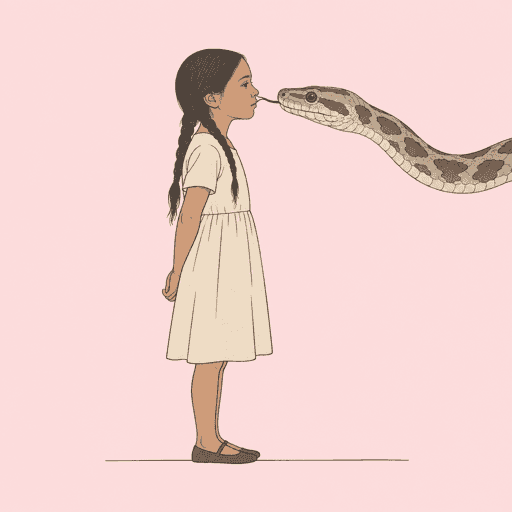
The upcoming fight makes the narrator recall a chaotic school assembly from a year earlier. During the show, a performer lost control of a young Burmese python and a tarantula. In the ensuing panic, the carriers of the African rock python dropped its case and rushed to help, and the Burmese python slid among the panicked children. The narrator fell before it, and it touched her face with its forked tongue before moving on. She calls this the “python’s kiss.”
At the arranged fight, the muscular Mr. Gamrod expects to win by a quick knockout, but the wiry Jurgen is elusive. Instead of brawling, Jurgen uses a wrestling style reminiscent of a constrictor, wrapping his limbs around Mr. Gamrod and squeezing him until he is exhausted and signals defeat. The narrator is transfixed with the idea of the boa constrictor for the rest of that night.
To prevent further escapes, Jurgen electrifies the top of the fence. Nero attempts to climb it, is shocked, then bites the live wire, which shorts out the property’s power and leaves the dog severely traumatized. Over the following year, Nero’s mental and physical health worsens. Confined to a cage, he breaks his teeth on an old iron cauldron and no longer recognizes the narrator. Eventually, with no warning, Jurgen shoots Nero. The narrator helps him dig a grave to bury the dog.
Story 1 Analysis
The narrator’s first feeling of self-awareness arrives while gazing into the eyes of Nero, her grandparents’ guard dog. Seeing her own eye color reflected in his, she realizes her “human life was arbitrary” and that she “could have been a dog” (4), a moment that initiates the story’s exploration of Human Intimacy With the Nonhuman. This recognition of shared being frames their relationship as a deep connection between two captives in different forms of incarceration. The narrator sees Nero as a “fellow prisoner” in the brutal, utilitarian world of the butcher shop, a sentiment that distinguishes her from the adults who view animals primarily as resources to be slaughtered, controlled, or used for warmth. By contrast, the narrator and Nero’s relationship is predicated on care, mediated by the gingersnaps that become the physical medium for their bond, a secret currency of empathy that transcends the verbal communication he shares with no one else. While Nero knows no other human words, the narrator teaches him “gingersnap,” and his only sign of understanding is “a keener look in his eyes, a stiller stillness” (5), suggesting a form of communication that is deeper and more instinctual than language.
The narrator’s memory of a chaotic school assembly introduces the central symbol of snakes, which re-frames the story’s understanding of power and conflict. The story’s title comes from this very episode, showing a moment when an animal regarded as a predator displayed an unexpected gesture that the recipient of that action perceived as tenderness. This experience is one of initiation; she feels “chosen—marked for wisdom or maybe sorrow” (14). The snake shows a form of power that is ancient, fluid, and indifferent to human panic, operating by its own non-human logic. Its touch is described as “dry and lighter than the stroke of a sable paintbrush” (14), stressing its delicacy and precision over brute force. The memory of this encounter, with the snake’s “impartial, primordial face” (13), becomes the interpretive lens through which she later understands her Uncle Jurgen’s surprising victory over Mr. Gamrod, as well as his relationships with everyone from Priscilla to Nero. The python’s quiet, inescapable strength provides a counterpoint to the loud, aggressive masculinity of men like Mr. Gamrod, whose power relies on conventional brawling. The snake, therefore, symbolizes an alternative and arguably more effective form of dominance, one rooted in patience, strategy, and an economy of motion.
The confrontation between Jurgen and Mr. Gamrod directly dramatizes this contrast between two forms of power. While the muscular Mr. Gamrod is a conventional fighter who expects a quick knockout, Jurgen’s method is explicitly serpentine. Jurgen doesn’t meet force with force; the narrative describes Jurgen’s attack as “one long stream of electric, muscular motion that connected beneath Mr. Gamrod’s fists” (15). This fighting style mirrors the way Jurgen handles animals in the slaughterhouse, using technique and leverage to achieve a “stilled submission” without overt struggle. He is a foil to both the barbell-trained Mr. Gamrod and to his own father, a “real wrestler” who won prizes through formal competition. Jurgen’s power is different: It is an instinctual knowledge of bodies, pressure, and exhaustion learned from the nonhuman world he inhabits, and it proves superior to the more performative versions of masculinity on display.
The entire story is rooted in the physical and psychological landscape of the family-run butcher shop, a setting that shapes the characters’ relationships to bodies, life, and death. The narrator’s world is defined by routine violence and the commodification of living creatures. Details like the rusted scalding tub, the constant presence of animal bones, and the “maps of blood that appeared and disappeared on my grandfather’s bleached, starched, ankle-length aprons” create an atmosphere where life is merely treated as raw material (3), rather than as an object of value in itself. It is a place where animal bodies are systematically disassembled for human consumption, a process overseen by Jurgen with dispassionate precision. This backdrop makes the narrator’s empathetic bond with Nero all the more significant; her decision to see him as a fellow being is a quiet rebellion against the dominant ethos of her environment. The casual, daily violence of the business also provides a contrast to the highly ritualized, almost theatrical violence of the arranged fight, which is treated as a community spectacle with rules and spectators. In the end, however, the most impactful act of violence is Jurgen’s quiet, unceremonious shooting of Nero, a return to the cold pragmatism of the slaughterhouse.
Ultimately, the narrative is presented as an act of recollection, framed by the adult narrator’s insistence on the clarity of her childhood memories and demonstrating the theme of The Persistence of Tactile Memory. She claims she can “still draw the stippled print on my grandmother’s homemade dresses” (3), grounding the story in a collage of sharp, sensory details: the smell of smoked sausages in the truck, the feel of waxed linoleum, and the taste of stale gingersnaps. These physical impressions anchor her identity and understanding of the past. The story’s climax comes with the electrocution and subsequent decline of Nero, a tragedy born from a technological solution failing to contain a natural impulse. His eventual burial, where the narrator helps lower him into the “timeless present,” transforms the dog from a living creature into a permanent fixture of her memory. Just as the python’s kiss was a physical touch that left an emotional imprint on the narrator, Nero’s life and death become a tangible part of the narrator’s personal history, an experience she concludes by stating, “I have seen him there many times in this long life” (19). This final line confirms that memory is an active presence in one’s life, a world built from physical encounters that refuse to fade.

Get in-depth, chapter-by-chapter summaries and analysis from our literary experts.
- Grasp challenging concepts with clear, comprehensive explanations
- Revisit key plot points and ideas without rereading the book
- Share impressive insights in classes and book clubs
Related Titles
By Louise Erdrich


















Featured Collections
Books on Justice & Injustice
View Collection
Challenging Authority
View Collection
Childhood & Youth
View Collection
Coming-of-Age Journeys
View Collection
Earth Day
View Collection
Fear
View Collection
Indigenous People's Literature
View Collection
Memory
View Collection
Mortality & Death
View Collection
National Book Awards Winners & Finalists
View Collection
Nature Versus Nurture
View Collection
Power
View Collection
Revenge
View Collection
Safety & Danger
View Collection