Python's Kiss
A modern alternative to SparkNotes and CliffsNotes, SuperSummary offers high-quality Study Guides with detailed chapter summaries and analysis of major themes, characters, and more.
Summaries & Analyses
Quizzes
NEWReading Tools
Story 7Chapter Summaries & Analyses
Content Warning: This section of the guide includes discussion of death, emotional abuse, physical abuse, and death by suicide.
Story 7 Summary: “Borsalino”
The narrator recounts her connection to a brown Borsalino hat, a gift she has owned for many years. In 1977, as a student, she travels to Venice for the first time. There, she meets a charming but mysterious young man named Enzo, who gives her a “thief’s tour” of the city’s hidden gardens, palazzos, and churches. Their tour ends on Isola San Michele, the cemetery island. After a strange encounter, the narrator learns from a local couple that Enzo has a bed in the cemetery and other places among the dead, and that he is descended from an ancient Venetian family of thieves.
Sixteen years later, the narrator returns to Venice with her two young daughters and her abusive husband. While on a water taxi, she stands to take a Polaroid picture of her family and is struck in the head by a low bridge. Her Borsalino hat protects her from a severe injury. Later, she examines the photograph taken at the moment of impact and is horrified to see her husband smiling with anticipation, revealing that he knew the bridge was coming and that he wished for her death. This confirms her long-held fear that the many “accidents” she and her children have suffered were intentional acts of abuse.
Distraught after dinner, the narrator visits Enzo’s crypt on Isola San Michele once again and confesses her fears to his spirit. When her husband angrily confronts her at the tomb, the broken stone releases a jet of black dust that he inhales. A few years later, the narrator leaves her husband and takes their children; charges are subsequently brought that the husband cannot face, and he dies by suicide. Many years later, while cleaning his remaining possessions out of her garage, she feels a wave of despair. She puts on her Borsalino, and its rattle transforms from a warning of fear into a sound of salvation, affirming her new life of freedom.
Story 7 Analysis
The narrator’s detailed description of her Borsalino hat, a “soft brown” felt object with a “wide grosgrain ribbon band and a generous brim” (105), establishes it as a central artifact in her life story. From the outset, the narrator imbues the hat with personal history and protective qualities; it holds emergency money, a parrot feather, and a snakeskin, making it a container for both practical survival and personal symbolism. The hat is also a key component of the self-assured identity the narrator constructs for her first trip to Venice, paired with a “sternly tailored green wool coat” and a “man’s paisley ascot” (105). This curated persona is a shield for the vulnerable student who “hated leaving home” yet plotted her escape. The hat’s protective role is literalized 16 years later during the water taxi incident, where it physically cushions the blow from a low bridge. More than a simple object, the hat serves as an anchor for the narrator’s identity and a physical record of her experiences, embodying the theme of The Persistence of Tactile Memory. Its continued presence across decades allows it to accrue layers of meaning, transforming from a youthful affectation into a talisman that both protects her body and channels intuitive warnings, charting her evolution from a hopeful traveler into a resilient survivor.
The introduction of Enzo, the pale ghost of a Venetian thief, deliberately shifts the narrative from a realistic travel memoir into a gothic romance, blending the mundane with the supernatural. Enzo is presented as a charming and knowledgeable guide who is “beautiful” with “dark opulent curls, sinful black eyes” (107). He exists in a liminal space, able to interact with the living while being intimately connected to the dead, sleeping in crypts and speaking to a mummy in an unknown language. This relationship exemplifies Human Intimacy With the Nonhuman, expanding the concept of the nonhuman to include the spectral. The narrator’s immediate trust in and affection for Enzo, a being who inhabits the city’s secret histories, contrasts sharply with the betrayal she later experiences from her human husband. Enzo’s “thief’s tour” is an authentic Venice of hidden gardens and ancient palazzi, while her husband’s trip involves a consumerist Venice of lavish breakfasts and hired taxis. Enzo’s thievery is framed as a noble act of cultural redistribution, while her husband’s theft of a napkin is a hollow performance of love. This juxtaposition suggests that true connection can be found in unconventional, even supernatural, forms, while the greatest threats often come from the most socially sanctioned relationships.
The Polaroid photograph taken at the moment of the bridge accident serves as the story’s important turning point, providing undeniable proof of the husband’s malevolence. Before this, the narrator’s suffering exists in a space of ambiguity, marked by a series of “accidents” that are easily denied or explained away. The photograph, however, captures a truth that words cannot: Her husband’s “avid, anticipating” expression confirms his passive participation in, and desire for, her death. This physical artifact transforms her internal fears into an external, verifiable reality, creating a powerful juxtaposition between modern, technological evidence and the ancient, intuitive warnings from the hat’s snakeskin. The narrator’s sudden identification with the squid in her pasta, “the poor creature with its bag of emergency ink, served up in a sauce of its own fear” (112), is a metaphor for her realization that she is being consumed by her husband’s calculated cruelty. The photograph becomes the catalyst that empowers her to act, breaking the cycle of abuse by providing objective evidence that validates her intuition and exposes the performative nature of her husband’s persona as a loving father.
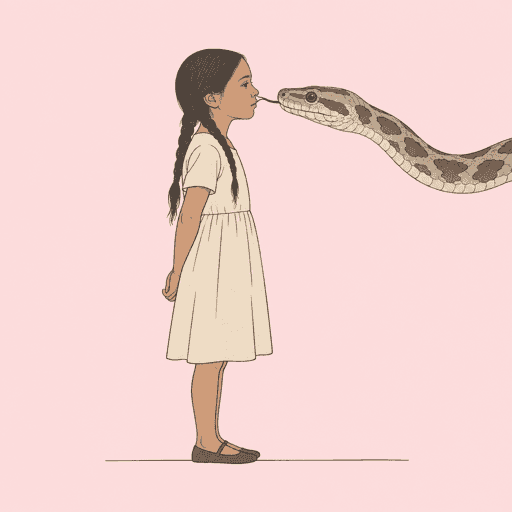
Throughout the narrative, the symbol of snakes is a source of instinctual power and protection. The snakeskin coiled in the hatband is a talismanic one, a nonhuman element integrated into the narrator’s most personal possession. Its rattle first warns her of danger at the mausoleum on Isola San Michele, acting as an extension of her own intuition. When her husband confronts her at Enzo’s tomb, his inhalation of the crypt’s black dust is a supernatural retribution, an act of protective venom from the world of the dead. Years later, after confronting the lingering trauma of her marriage, the rattle’s sound transforms. As she despairs in her garage, the hat begins “rattling and vibrating now, but not from fear, for the sound was gathering into a noise of salvation close to ecstasy” (116). This shift in the symbol’s meaning reflects the narrator’s internal transformation. The snake, an animal that sheds its skin to grow, mirrors her own journey of shedding the identity imposed upon her by an abusive relationship. The final sound is a celebration of survival, affirming the narrator’s hard-won freedom and the fierce, life-affirming energy she has reclaimed.

Get in-depth, chapter-by-chapter summaries and analysis from our literary experts.
- Grasp challenging concepts with clear, comprehensive explanations
- Revisit key plot points and ideas without rereading the book
- Share impressive insights in classes and book clubs
Related Titles
By Louise Erdrich
















Featured Collections
Books on Justice & Injustice
View Collection
Challenging Authority
View Collection
Childhood & Youth
View Collection
Coming-of-Age Journeys
View Collection
Earth Day
View Collection
Fear
View Collection
Indigenous People's Literature
View Collection
Memory
View Collection
Mortality & Death
View Collection
National Book Awards Winners & Finalists
View Collection
Nature Versus Nurture
View Collection
Power
View Collection
Revenge
View Collection
Safety & Danger
View Collection