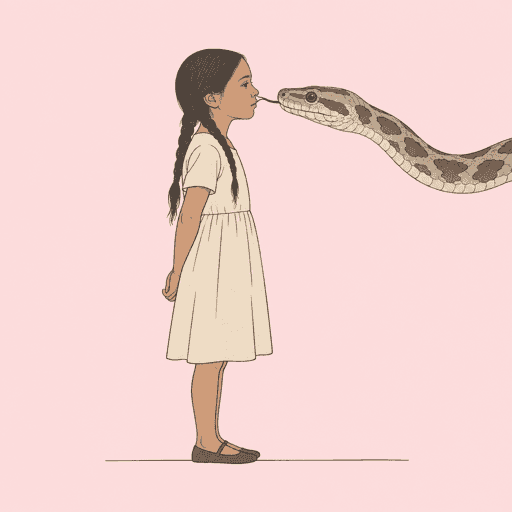
Python's Kiss
A modern alternative to SparkNotes and CliffsNotes, SuperSummary offers high-quality Study Guides with detailed chapter summaries and analysis of major themes, characters, and more.
Summaries & Analyses
Quizzes
NEWReading Tools
Story 3Chapter Summaries & Analyses
Content Warning: This section of the guide includes discussion of child death and mental illness.
Story 3 Summary: “The Hollow Children”
At a bar, men engage in “history farming,” telling stories about their ancestors. One man, Diz, recalls a story his grandfather told about his own Uncle Ivek, a part-time teacher and bus driver who lived through the lethal blizzard of 1923. Ivek later wrote an account of his experience.
On a mild April morning, a blizzard struck suddenly while Ivek was driving a bus nearly full of children. A northwest wind of 60 miles an hour dropped the temperature instantly and created a whiteout. Knowing they would die if he stopped, Ivek drove through the storm with zero visibility. Ivek called for a song; Agnid Awbrey, a resourceful 11-year-old girl, began “Wild Clover” and taught the other children the words, keeping spirits up as they sang loudly to stay warm and courageous. While driving, Ivek worried about the children’s parents and felt relieved that his own children had stayed home sick that day. Agnid also organized the sharing of lunches, even ensuring Ivek received a meat pie.
Under extreme stress, Ivek sensed a slickness beneath the wheels and feared the bus would crash through the ice. Later, at dusk, the bus fell into the lake. In Ivek’s perception of the sinking, the children became transparent and hollow, and when he heard his own children’s voices and realized they had got on the bus after all, he felt overwhelmed with sorrow. He snapped out of the vision when he caught a brief glimpse of the school nearby; his arms, acting on faith from that glimpse, guided the bus to the school.
Ivek and Agnid guided the children from the bus to the school in a human chain. Inside, Ivek started a fire but remained tormented by his vision, unable to distinguish it from reality. Agnid gave him a cup of hot water steeped with boiled wool to prevent him from experiencing “wind sickness,” a condition where the mind starts hearing human voices in the wind’s moans. The remedy grounded him, but the vision of the hollow children left a permanent mark on Ivek, prompting him to write his story down.
Story 3 Analysis
The story opens with men engaging in the act of “history farming,” which frames Ivek’s ordeal as a piece of communal lore. This story-within-a-story structure immediately establishes the events as part of a collective memory, passed down orally from grandfather to grandson before the text transitions to Ivek’s own written account. This layering of transmission explores how personal trauma becomes public history. The men trade stories of “antecedents’ exploits and agonies” like commodities (47), cultivating a shared past. The narrative’s authenticity is both heightened and complicated by this frame; it is grounded in the physical evidence of Ivek’s notebook, yet it is also a performance, a story traded “around beer number four” (47). Ivek’s written record of his experience provides a tangible anchor for his disorienting psychological crisis during his vision, an effort to give shape to an unspeakable event. This effort connects to the theme of The Persistence of Tactile Memory, where the physical artifact of the notebook becomes the vessel for a memory that defies time, ensuring its survival across generations. The story is presented as both a personal testament and a regional legend, its power residing in its capacity to be both preserved and retold.
The blizzard functions as more than a setting; it is a natural threat that assaults Ivek’s psychological stability by erasing the known world. Before the storm hits, the narrative establishes the landscape as a “time eternal” expanse where the “human presence […] was slight” (48), suggesting that nature’s power is the default state and human settlement is a fragile imposition. The storm, a “boiling white mass rolling at him like annihilation” (47), becomes an expression of this indifference, a force that scours away all visual cues and forces Ivek to navigate by instinct and feel. This sensory deprivation induces a state of extreme mental stress where the boundary between perception and hallucination dissolves. Ivek’s fear of driving onto a frozen lake manifests long before his climactic vision, his “blighted mind” imagining the plunge despite knowing the ice is solid. Moreover, the fear of catching “wind sickness” codifies Ivek’s fear of psychological crisis as a recognizable affliction, a direct consequence of the landscape’s power over human consciousness.
Amid the disorienting chaos of the storm, the narrative establishes a powerful contrast between adult anxiety and childhood resilience through the character of Agnid Awbrey. While Ivek experiences paranoia and terror, the 11-year-old girl becomes a bastion of practical leadership. She initiates songs to keep spirits up, organizes the fair distribution of food, and later administers a grounding folk remedy to Ivek. Her actions are consistently focused on maintaining the group’s cohesion and morale. The songs she teaches are tools of survival. “Wild Clover” contains a promise of rebirth, while the chant about “[f]ire in our hearts” becomes a rhythmic, warming ritual against the cold (49). Agnid’s steady competence provides an essential counterweight to Ivek under the duress of crisis, demonstrating a form of strength rooted in communal care rather than solitary endurance. While she is not immune to the danger, her response to the indifferent, isolating force of the blizzard is to reinforce social bonds as a shield.
Ivek’s vision of the titular “hollow children” serves as the chapter’s climactic image, translating his abstract fears into a concrete, traumatic visual. Seeing the children become “transparent and so frail that they were almost unbearably weighted down by their clothing” is a haunting metaphor for their extreme vulnerability and the crushing weight of Ivek’s responsibility to them (51). The vision’s horror intensifies when he hears his own children’s voices. This moment collapses the distance between his professional duty and his personal terror. Even after he physically delivers the children to the school, the vision’s reality remains more potent than the warmth of the stove, forcing him to question, “What was up and what was down?” (52).
The narrative deliberately blurs the lines between objective events, psychological stress, and outright hallucination to explore the unreliable nature of perception under extreme duress. The moment Ivek snaps back to reality is marked by a subtle but deep distinction: “Ivek’s eyes were open but somehow they opened” (52), implying a shift between mere sight and true perception. In the depths of his confusion, his body retains a knowledge his mind has lost; he doubts what he sees, but his “arms had faith” and guide the bus to safety (52). This reliance on instinct highlights the limits of rational thought in the face of annihilation. The vision leaves a permanent “mark upon him” (53), compelling him to write the story down. This final act is an attempt to impose a linear narrative on a chaotic experience and to make sense of a psychological wound that has become as real and lasting as the physical journey itself.

Get in-depth, chapter-by-chapter summaries and analysis from our literary experts.
- Grasp challenging concepts with clear, comprehensive explanations
- Revisit key plot points and ideas without rereading the book
- Share impressive insights in classes and book clubs
Related Titles
By Louise Erdrich











Featured Collections
Books on Justice & Injustice
View Collection
Challenging Authority
View Collection
Childhood & Youth
View Collection
Coming-of-Age Journeys
View Collection
Earth Day
View Collection
Fear
View Collection
Indigenous People's Literature
View Collection
Memory
View Collection
Mortality & Death
View Collection
National Book Awards Winners & Finalists
View Collection
Nature Versus Nurture
View Collection
Power
View Collection
Revenge
View Collection
Safety & Danger
View Collection