Python's Kiss
A modern alternative to SparkNotes and CliffsNotes, SuperSummary offers high-quality Study Guides with detailed chapter summaries and analysis of major themes, characters, and more.
Summaries & Analyses
Quizzes
NEWReading Tools
Character Analysis
Content Warning: This section of the guide includes discussion of animal cruelty, animal death, emotional abuse, addiction, child death, mental illness, and death.
The Narrator (“Python’s Kiss”)
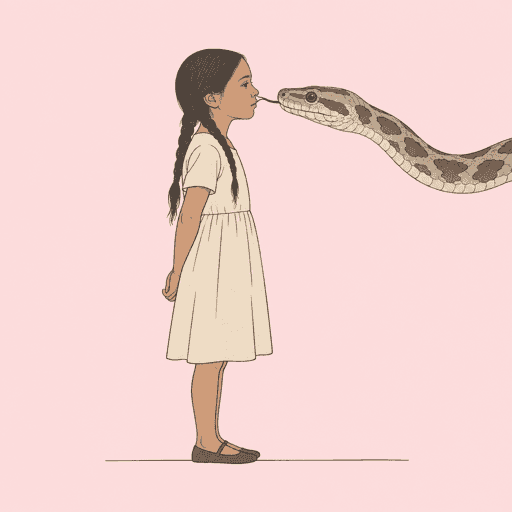
The unnamed child narrator of the title story is an observant, emotionally responsive protagonist whose stay at her grandparents’ butcher shop shapes her understanding of other creatures. Wearing boys’ clothes and often mistaken for a boy, the narrator inhabits the margins of an adult world organized around the practical use of animals. Her sympathy for the guard dog Nero challenges that order: She experiences “the first intimations of sympathy for another form of creation” (4). She secretly offers gingersnaps to Nero, making Human Intimacy With the Nonhuman a relationship enacted through small gestures rather than declared principles.
The narrator’s sensitivity contrasts with Uncle Jurgen’s physical mastery, displayed in both slaughterhouse work and his fight with Mr. Gamrod. Where Jurgen controls bodies, the narrator attends to suffering, sitting beside Nero after his electrocution. The dog’s subsequent decline and burial make sympathy inseparable from loss. The narrator’s precise sensory recollections convey the lasting force of this early moral awakening.
Dora (“Wedding Dresses”)
Dora, the protagonist of “Wedding Dresses,” combines pragmatism, artistic independence, and an enduring capacity for attachment. Her niece Martha’s questions draw out memories of her four marriages through the dresses stored in ruined bags. The women who sew her first wedding dress also teach her how to leave a marriage, making self-preservation part of the family knowledge she inherits. Yet her ability to leave does not make her emotionally detached, especially in her grief for Samuel.
The relationships reveal different pressures on Dora’s identity: Merritt’s expectations, Johnny Ermine’s betrayal, Samuel’s alcohol addiction, and Roberta’s insistence on secrecy. Her refusal to remain hidden demonstrates dignity rather than disillusionment. Retaining the green dress she wore during her marriage to Samuel and salvaging beadwork from Roberta’s gown express The Persistence of Tactile Memory, allowing affection and injury to remain tangible in the wake of the marriages. Dora receives a different kind of intimacy from Martha, which is sustained by attention rather than romantic promises. Their conversation presents Dora as both an experienced adult and someone still discovering what her losses mean.
Bernadette (“Domain”)
Bernadette, the protagonist of “Domain,” is a building climber and artist whose trained visual memory becomes both a creative resource and a means of concealment. After a catastrophic fall, she enters Asphodel, a corporate afterlife that draws on inhabitants’ memories to build its environment. Her ability to screen her thoughts with remembered skies establishes her discipline and resistance to scrutiny. It also places her within the framework of The Commodification of Disembodied Life: a private inner world becomes valuable material for a company.
Bernadette’s goal is revenge against her father, who failed to summon an afterlife rescue service for her dying son Edan but later entered Asphodel himself. His apparent abandonment of his earlier religious convictions intensifies her grief. Her planned attack uses a brick, echoing the instrument of Edan’s death. This symmetry makes violence an attempt to answer loss rather than escape it. The appearance of her son’s face at the climax interrupts any simple resolution of her anger.
Caroline (“Asphodel”)
Caroline, the central character in “Asphodel,” develops from a temporary projection into a character who challenges the terms of her existence. Her mother Evlin’s contract makes successive versions of the child disposable. Caroline’s refusal to accept that arrangement distinguishes her from the role assigned to her. Her anger is both personal and structural: Maternal comfort depends on repeatedly extinguishing a daughter’s future.
After reversing the power relationship with Evlin, Caroline reshapes her body and explores the domain through sensation and desire. The environment responds as something more than decorative scenery, allowing her to form a relationship with the world itself. Her curiosity, defiance, and capacity for transformation undermine the distinction between an artificial inhabitant and a supposedly authentic person. As a dynamic protagonist, she exposes the violence implicit in The Commodification of Disembodied Life while discovering possibilities that exceed the company’s original designs for the afterlife.
Carleen (“December 26”)
Carleen, the narrator of “December 26,” is a tribal newsletter editor and single mother whose practical competence meets a crisis beyond her familiar resources. Her impulse to smudge the house reflects a desire to restore order as revelations about her son Delvin become increasingly frightening. Community knowledge, ritual, and household management cannot by themselves resolve his entanglement in a drug operation.
Delvin’s confession reveals animal trafficking, personal involvement in transporting drugs, and debts that threaten the family. His accusations against Carleen’s brother Raf introduce uncertainty into a relationship she normally relies on. Kenny Thunder, her ex-husband, offers affection without dependable protection. These unstable sources of help expose the burden Carleen carries. Her love for her children and unexpected grandchild remains the strongest continuity in a world whose rules have suddenly become dangerous.
The Narrator (“Borsalino”)
The narrator of “Borsalino” is a survivor whose account of an abusive marriage unfolds through her relationship with a cherished hat. Already hers when she reaches Venice, the Borsalino accompanies experiences that resist ordinary explanation. Enzo, the mysterious young man who guides her through the city, connects her to a world beyond the predictable routines of tourism and marriage. The snakeskin in the hatband warns her away from danger, and the brim later cushions a blow from a bridge.
Her husband’s expression in a photograph taken just before that impact reveals a disturbing awareness of what is about to happen. Recognizing his cruelty changes the meaning of a relationship she has endured. The hat becomes an enduring link between bodily survival and emotional recognition, expressing The Persistence of Tactile Memory. Her eventual laughter marks a release from his power, making her development a movement toward self-possession rather than simply an escape from injury.
Mr. Ponath/Amelia (“Amelia”)
Mr. Ponath, the professor at the center of “Amelia,” combines public eccentricity with private generosity. Dressing as Colonel Sanders and socializing at KFC, he creates a recognizable role through which he offers company and material help. His support for the young narrator’s education makes him a mentor whose influence extends beyond the restaurant’s limited opportunities.
The account of his twin sister Amelia complicates that benevolent persona. The wig, the missing Amelia photograph, and Amelia’s sudden appearance and management of Mr. Ponath’s affairs invite speculation that the siblings may represent two identities belonging to one person. However, the narrator entertains this possibility without establishing it as fact. Their apparent involvement in changing the restaurant’s ownership similarly links theatrical self-presentation with practical intervention. Mr. Ponath and Amelia challenge the assumption that knowing someone’s public habits means knowing their life. The unresolved expectation of a letter keeps that uncertainty open while preserving the narrator’s gratitude.
Ivek (“The Hollow Children”)
Ivek, the farmer, part-time schoolteacher, and bus driver at the center of “The Hollow Children,” is a static but round character whose single crisis reveals his full moral shape. Caught in a blizzard with a busload of children, he drives on pure instinct and improvisation, keeping the children singing to maintain warmth and morale. His psychological crisis is one of permeability: The boundary between the freezing surface world and the lake bottom beneath the ice becomes genuinely unstable in his mind, and the children briefly transform into hollow, transparent figures in the water.
The vision unsettles the boundary between physical danger and overwhelming fear. Agnid, the 11-year-old who organizes the food, leads the songs, and finally presses a cup of melted snow steeped with boiled wool into his hand as a cure for “wind sickness,” is the practical intelligence that keeps both Ivek and the children intact. She functions as an unsentimental sidekick, her competence exceeding the adults around her.
John Timble (“Love of My Days”)
John Timble, the fugitive at the center of “Love of My Days,” is a round and ultimately sympathetic character whose violence is inseparable from his dislocation. A drifter who has worked the farms of the Red River Valley for years, he enters a house he insists is his own and kills a sheriff in a moment of sudden fury that he himself cannot explain, comparing it afterward to a hungry spirit that seized him briefly.
His subsequent flight is less an escape than a prolonged farewell: He enjoys the horses, notices the winter jackrabbits, and accepts Karlet Cherian’s hospitality with genuine grace. The story closes with his dead beloved Beatril walking toward him across the snow, suggesting that his final moment of consciousness is one of reunion rather than punishment.
Maxine (“Assassin”)
Maxine, the mother-protagonist of “Assassin,” is a grounded, observant character whose generosity repeatedly outpaces her stated limits. She wades into a dangerously cold lake to join others helping a girl, drives a stranger across the city, and buys pizza for two teenagers.
Her attempts to critique the game of Assassin are undercut by her daughter Crimson’s quiet, devastating argument that for teenagers who run active-shooter drills, playing a war game is a form of preparation rather than frivolity. Maxine freezes at this and cannot argue back. Her role is less that of an authority figure than of a witness, someone whose presence creates a space in which the girls can act, recover, and plan.
The Narrator (“The Feral Troubadour”)
The narrator of “The Feral Troubadour” is a self-aware poet who lives in a converted attic with a tiled bathroom in which he hand-copies the texts of different poems. His project of trapping and rehoming feral cats is a comic extension of his temperament: He cannot leave damaged creatures to their fates, whether they are cats, strumming strangers, or his own periodic conviction that he is an outcast from ordinary life.
His ambivalence toward the troubadour, whom he both resents and involuntarily protects, resolves into something like mercy. He gives the man an alibi despite having grounds not to, and is rewarded less with gratitude than with the information that the cat defended itself heroically.
The Narrator (“Big Cat”)
The narrator of “Big Cat” is a former bit-part actor whose self-knowledge is more complete than his behavior suggests. He understands that he married his second wife Laurene partly because she sleeps silently, understands that his affair with Elida is a relapse into a love he never resolved, and understands that taking Laurene’s money in the divorce settlement is ignoble even as he does it.
His ex-wife Elida edits his minor film appearances into a coherent downward narrative titled Man of a Thousand Glimpses, a gift that functions as an inadvertent verdict on his life. Watching it on the large screen bought with Laurene’s money, the narrator recognizes the trajectory Elida has assembled for him and destroys the film. The story closes with him lying awake in the snoring house, his imagined lion hunt becoming so vivid that he genuinely cannot locate the boundary between Elida’s sounds and predation, suggesting that the intimacy he has pursued across two marriages remains one he cannot quite bear.
The Protagonist (“The Stone”)
The unnamed woman of “The Stone” is a round, dynamic character whose entire arc unfolds in relation to a piece of basalt she finds as a girl in a birch clump on a Lake Superior island. She carries it through childhood anxiety, adult solitude, a concert career, and a marriage, setting it beside the piano at rehearsals and performances. Her human relationships are genuine but consistently secondary to this primary bond, which she maintains through oiling, careful placement, and a sustained attention the stone appears to return.
When she drops and chips the stone, the protagonist becomes disillusioned with its spell and briefly opens herself to Ted. However, the marriage cannot hold against the distance she does not know she is creating. She repairs the stone with a nearly invisible seam, resumes their companionship, and dies with it beside her. Her life is the collection’s fullest statement of The Persistence of Tactile Memory, proposing that the most enduring intimacy is sometimes with the nonhuman world.

Unlock analysis of every major character
Get a detailed breakdown of each character’s role, motivations, and development.
- Explore in-depth profiles for every important character
- Trace character arcs, turning points, and relationships
- Connect characters to key themes and plot points
Related Titles
By Louise Erdrich

















Featured Collections
Books on Justice & Injustice
View Collection
Challenging Authority
View Collection
Childhood & Youth
View Collection
Coming-of-Age Journeys
View Collection
Earth Day
View Collection
Fear
View Collection
Indigenous People's Literature
View Collection
Memory
View Collection
Mortality & Death
View Collection
National Book Awards Winners & Finalists
View Collection
Nature Versus Nurture
View Collection
Power
View Collection
Revenge
View Collection
Safety & Danger
View Collection