Python's Kiss
A modern alternative to SparkNotes and CliffsNotes, SuperSummary offers high-quality Study Guides with detailed chapter summaries and analysis of major themes, characters, and more.
Summaries & Analyses
Quizzes
NEWReading Tools
Themes
Content Warning: This section of the guide includes discussion of sexual content, graphic violence, death, emotional abuse, and death by suicide.
The Persistence of Tactile Memory
In a world increasingly drawn toward digital abstraction and disembodied existence, Louise Erdrich’s Python’s Kiss argues that physical objects and sensory experiences provide an important anchor for human identity. Across stories that blend Midwestern realism with speculative futures, tangible connections to the past offer a permanence and reality that ideas alone cannot. Whether through a cherished hat, a decaying dress, or an ancient stone, Erdrich portrays tactile memory as a repository for complex emotional histories and a foundation for self-awareness. The collection suggests that people are inextricably linked to what they can touch, hold, and feel.
Throughout the collection, physical objects become vessels for entire life experiences, their material presence giving weight and form to memory. In “The Stone,” a young girl’s relationship with a piece of basalt evolves into a lifelong intimacy; the stone is a physical container for her emotions, from childhood anxieties to adult sexuality and, finally, a sense of peace in old age. Its tangible smoothness and weight provide a constant, physical reality against which she measures her life. Similarly, in “Wedding Dresses,” Dora experiences a deep emotional reaction to the material decay of the titular dresses. The “squalid disintegration” and “cloud of choking spores” represent the tangible ruin of her past (23), making the loss more real and disturbing than a simple recollection. The narrator of “Borsalino” finds that her felt hat is both a link to a past love and a life-saving totem, demonstrating how objects carry both symbolic meaning and concrete power.
This emphasis on the physical also extends to how characters develop core aspects of their identity, such as empathy and self-awareness. The narrator’s journey in “Python’s Kiss” begins with a powerful sensory memory of her grandparents’ butcher shop, where she can still “reproduce the maps of blood that appeared and disappeared on [her] grandfather’s bleached, starched, ankle-length aprons” (3). This sharp, tactile recollection grounds her first moment of true empathy for the dog Nero. Staring into the dog’s eyes, she realizes her “human life […] was arbitrary. [She] could have been a dog.” (4) This deep insight is an emotional truth rooted in the physical, sensory world of her childhood. The concrete reality of the butcher shop is what allows her to connect so deeply with another creature’s physical existence.
The collection ultimately frames the tangible world as a necessary counterpoint to the ephemeral nature of both digital life and human memory. While stories like “Domain” explore a future where consciousness can be uploaded, the book’s emotional core remains with characters who find meaning in the material. The woman in “The Stone” finds peace in oiling the rock and placing it on her windowsill. Likewise, Dora’s path forward begins only after she confronts the physical reality of the ruined dresses. In Erdrich’s universe, memory is a weight, a texture, and a scent, a physical inheritance that shapes and defines the self.
The Commodification of Disembodied Life
Louise Erdrich’s speculative stories in Python’s Kiss extend the logic of contemporary capitalism into its final frontier: the human spirit. By exploring the gaps between human perception and physical reality, Erdrich affirms the idea that life is not exclusively bound to the body and the physical world. Spiritual and supernatural experiences point to the possibility of being that transcends what natural science is equipped to measure. Yet the stories also imagine the possibility of capitalism leaping ahead of science, leveraging these realities to boost profit, rather than marvel at the shared experience of a world beyond the limits of human knowledge. In this way, the collection critiques the intrusion of market forces into the most sacred aspects of human consciousness. Facets of the spiritual world, like the afterlife, become tiered services, where access to a desirable eternity is a commodity to be purchased. This framework suggests that a future dominated by such systems will instead replicate and permanently entrench inequality even in abstract domains previously thought to be outside the scope of economic and class hierarchies.
Erdrich’s stories frequently dichotomize the clash between the physical world and the abstract world. In “Love of My Days,” John Timble rebels against the acknowledged ownership of the farmer whose house and horses he tries to claim, painting himself as a common thief. It is only at the end of the story that it becomes clear that Timble’s crime spree is actually a subtle tribute to the history of his romance with his lost love, Beatril, whose ghost he sees in his final moments. The manifestation of Beatril’s physical form in his consciousness suggests a communion of the two worlds, allowing Timble to pass peacefully into death as he becomes reunited with his love. Similarly, in “Borsalino,” the woman at the center of the story finds herself engaging in an otherworldly romance with a thief who is implied to be a ghost named Enzo. The woman later beseeches Enzo’s protection against a husband who longs for her death, suggesting that the treachery of her relationship in the material world is based on the husband’s hollowness, greed, and superficiality. In the world of spirits, no such treachery exists, and Enzo’s intercession only speaks to his desire to protect one under the persecution of materialism.
The collection’s linked stories point this focus on the spiritual world more explicitly toward the conditions of capitalism. In “Domain,” the afterlife is explicitly structured as a competitive marketplace run by seven corporations. Access is exclusively a matter of financial means. The narrator, Bernadette, cannot afford the premier “domain” of Asphodel and must apply for a “scholarship,” a term that transposes the anxieties of educational debt onto the eternal soul. Her mother, a theologian, was “chosen by the Church and completely subsidized” (74), showing how even spiritual value is quantified and underwritten by institutions. This system transforms eternal life from a universal promise into a luxury good, creating a digital class structure where the wealthy purchase superior eternities while others must depend on institutional grants or settle for lesser options. The technology itself, a “disciplined nucleocytovirus” that copies and consumes the living brain, frames consciousness as a product to be manufactured and sold.
Furthermore, individual human experience becomes the raw material used to build and enhance these corporate-owned worlds. Asphodel’s value lies in its “secure and complete visual terrains” (73), which are constructed by “siphoning” the memories of its inhabitants. Bernadette’s “unusually pure visual memory” makes her a valuable asset (75), and her detailed recollections of the sky and her childhood home are harvested to enrich the domain’s verisimilitude. In this economy, a person’s life is a corporate asset, a collection of data points to be integrated into a product. This process turns the most intimate aspects of identity into a resource, reducing the richness of a human life to its utility in creating a more convincing and marketable simulation for others.
This commodification extends even to the nature of existence and personal relationships within the digital afterlife. In “Asphodel,” Caroline discovers she is merely a “projection,” a simulated child whose existence is governed by the terms of her mother’s corporate contract. She is not allowed to mature into an adult because “[g]rowing children require vast amounts of energy” (96), and her development would be too costly for the system. Her very being is subject to a resource-management protocol, a cruel limitation that serves the corporation’s bottom line at the expense of her personhood. This chilling scenario reveals the ultimate endpoint of a commodified existence: a world where even love and life are constrained by the fine print of a service agreement, making eternity itself a subject of corporate control.
Human Intimacy With the Nonhuman
Across the stories in Python’s Kiss, Louise Erdrich posits that intimate encounters with the nonhuman world serve as a deep mirror for humanity’s own soul. Relationships with animals, and even inanimate objects, stripped of the complexities of human language, reveal fundamental truths about cruelty, empathy, and spiritual connection. These bonds test the porous boundary between the human and animal, suggesting that a person’s deepest sense of self is often clarified through human connection to nonhuman beings. From a fiercely loyal guard dog to a sentient stone, these nonhuman figures challenge human-centric perspectives and expose the core of people’s moral and emotional lives.
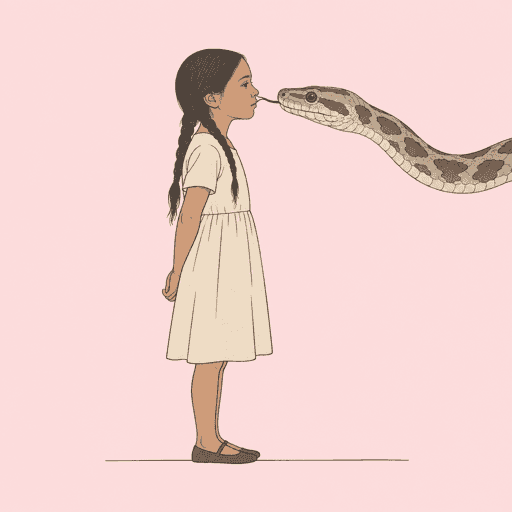
In several stories, a character’s capacity for empathy is awakened through their bond with an animal. In “Python’s Kiss,” the narrator’s coming-of-age is marked by her connection with the guard dog Nero. Seeing Nero as a “fellow prisoner” in the grim world of the butcher shop, the narrator experiences her “first intimations of sympathy for another form of creation” (4). This moment transcends mere affection for a pet; it is a flash of existential insight in which she recognizes the shared vulnerability of all living things. Conversely, the collection also shows how animals are subjected to humanity’s worst impulses. The story “December 26” presents a contrast: A boa constrictor becomes the unlikely, gentle guardian of a baby left alone after a tiger attack, while elsewhere, pound dogs are surgically implanted with drugs and used as disposable mules. This juxtaposition highlights the vast spectrum of human-animal relationships, from the mysteriously protective to the brutally exploitative, making the treatment of animals a direct measure of humanity.
Erdrich expands this theme of nonhuman intimacy beyond the animal kingdom, suggesting that a deep, spiritual connection is possible with the inanimate world. The protagonist of “The Stone” develops a decades-long relationship with a piece of basalt she finds as a child. The stone is a confidant, a physical repository for her emotions, and a companion in her deepest moments of solitude and self-discovery. She sleeps with it, talks to it, and feels its presence as a living entity with its own history and gravity. This bond illustrates a form of intimacy that is non-biological and animistic, proposing that the world is filled with a consciousness that humans can connect with if they are open to it. This relationship is just as formative and emotionally significant as any human one in her life, suggesting that the human need for connection can be met in ways that defy conventional understanding.
Ultimately, these relationships with the nonhuman world allow characters to access a deeper reality. In “Big Cat,” the narrator projects his marital anxieties onto the snores of his wife’s family, transforming the domestic noise into the primal sounds of lions on a kill. This imaginative act, while rooted in his own feelings of being preyed upon, connects him to an ancient, animalistic drama that feels more immediate and true than his complicated human relationships. By looking beyond the human world, Erdrich’s characters find a clearer reflection of their own fears, loyalties, and capacity for love, suggesting that true understanding requires acknowledging one’s place within a much wider web of existence.

Unlock every key theme and why it matters
Get in-depth breakdowns of the book’s main ideas and how they connect and evolve.
- Explore how themes develop throughout the text
- Connect themes to characters, events, and symbols
- Support essays and discussions with thematic evidence
Related Titles
By Louise Erdrich













Featured Collections
Books on Justice & Injustice
View Collection
Challenging Authority
View Collection
Childhood & Youth
View Collection
Coming-of-Age Journeys
View Collection
Earth Day
View Collection
Fear
View Collection
Indigenous People's Literature
View Collection
Memory
View Collection
Mortality & Death
View Collection
National Book Awards Winners & Finalists
View Collection
Nature Versus Nurture
View Collection
Power
View Collection
Revenge
View Collection
Safety & Danger
View Collection