Python's Kiss
A modern alternative to SparkNotes and CliffsNotes, SuperSummary offers high-quality Study Guides with detailed chapter summaries and analysis of major themes, characters, and more.
Summaries & Analyses
Quizzes
NEWReading Tools
Symbols & Motifs
Content Warning: This section of the guide includes discussion of animal cruelty and animal death.
Snakes
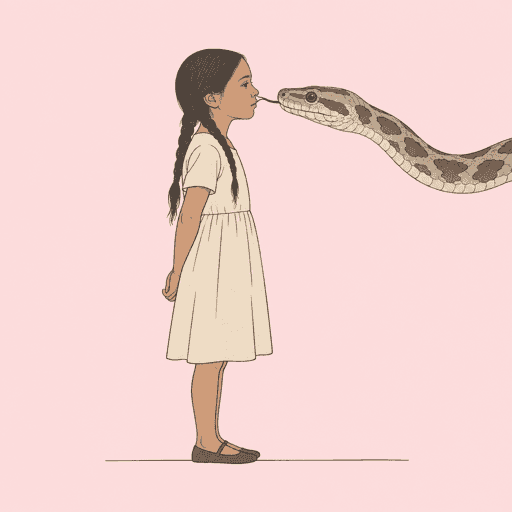
The snake is a recurring motif for a primal, amoral force of nature operating beyond human rules of good and evil. Appearing in multiple stories, it embodies a spectrum of possibilities, from deadly threat to unlikely protector, showing the complex reality of Human Intimacy With the Nonhuman. In “Python’s Kiss,” the snake appears first as an exotic, dangerous creature in a school show, its touch leaving the narrator with a feeling of being “chosen—marked for wisdom or maybe sorrow” (14). This encounter foreshadows the narrator’s bond with the guard dog Nero, another powerful and misunderstood creature.
Snakes also serve as protectors, though their motivations for safeguarding people are left deliberately ambiguous and inexplicable. In “Borsalino,” the snakeskin coiled in the inner band of the titular hat is a psychic alarm system, rattling to warn the woman of danger and reinforcing her gut feelings. When Enzo leads the woman to a “cozy mausoleum,” her hat “rattled, as if the snakeskin in the hatband had come alive and moved” (108), prompting her to refuse his invitation and avoid an ambiguous but threatening fate. Later, in “December 26,” the motif returns with even greater ambiguity. A boa constrictor becomes the guardian of an abandoned baby, wrapping itself protectively around the child. Through these contrasting appearances, the snake motif collapses simple distinctions between good and evil, suggesting that the nonhuman world contains its own deep and inscrutable logic, capable of both immense danger and deep guardianship.
The Wedding Dresses
In the story “Wedding Dresses,” the four ruined garments are a potent symbol of failed relationships and the messy, physical reality of the past. For the protagonist, Dora, the dresses are tangible artifacts of her former lives, and their decay forces a confrontation with memory that is visceral rather than nostalgic. This connection to the theme of The Persistence of Tactile Memory is established immediately; Dora reflects, “It wasn’t the loss of the actual dresses, […] it was their squalid disintegration that was so disturbing” (23). The language used to describe them centers markers of decay like “pink-green bubbles of mold” and “a cloud of choking spores” (23). This transforms them from idealized symbols of love into a foul, organic mass. They become “bride gowns for zombies” (24), a grotesque reflection of love’s death.
This physical reality contrasts sharply with the controlled, narrative versions of her past that she constructs for her niece, Martha. While Dora can edit and soften the stories of her marriages, she cannot escape the tangible, malodorous evidence of their endings. The ruined dresses symbolize the unavoidable truth that the past is a material presence that rots, grows, and asserts its own unpleasant reality.
Asphodel
The corporate-run afterlife of Asphodel is a symbol for the relentless expansion of capitalism into the most sacred and intimate realms of human experience. This concept is central to the book’s critique of The Commodification of Disembodied Life, portraying a digital heaven where eternity is a product and consciousness is a resource. In “Domain,” entry into this afterlife is a financial and logistical transition, governed by contracts, proprietary technology, and even a “scholarship” for which the narrator must apply. Her value to the corporation is her “unusually pure visual memory” (75), a personal faculty that Asphodel intends to harvest. The system is built by siphoning memories from its inhabitants, turning the sum of human experience into a corporate asset used to construct a “fascinatingly detailed piece of work” (94).
This commodification extends to procreation in the story “Asphodel,” where Caroline learns she is a temporary projection whose growth is limited by her mother’s service contract, designed to conserve the system’s energy. Later, Caroline turns the contract against her mother, using her newfound freedom to alter herself in ways that attract Asphodel’s collective consciousness. The “we” that speaks throughout this story begins to covet Caroline’s abilities, seeing their potential for expanding the world that Asphodel represents. By framing salvation and family through the language of commerce and resource management, Asphodel symbolizes a future where the human soul, memory, and the promise of eternal life have been fully absorbed into a corporate balance sheet.
The Borsalino Hat
The narrator’s brown Borsalino hat in “Borsalino” is a symbol of both protection and intuition, a physical object that embodies the theme of The Persistence of Tactile Memory. More than just an accessory, the hat functions to connect the narrator to a formative past and safeguard her in the present. Its role as a protector is literal: It saves her from a serious head injury in a water taxi accident, absorbing the impact from a low bridge. This tangible act of preservation is mirrored by its more subtle, intuitive function. As a “present from someone I dearly loved” (105), the hat is a constant, physical link to her past, but its power transcends mere nostalgia. By functioning as both a physical shield and a conduit for intuition, the Borsalino symbolizes how cherished objects can carry a protective power that is both materially real and deeply mysterious.

Unlock the meaning behind every key symbol & motif
See how recurring imagery, objects, and ideas shape the narrative.
- Explore how the author builds meaning through symbolism
- Understand what symbols & motifs represent in the text
- Connect recurring ideas to themes, characters, and events
Related Titles
By Louise Erdrich









Featured Collections
Books on Justice & Injustice
View Collection
Challenging Authority
View Collection
Childhood & Youth
View Collection
Coming-of-Age Journeys
View Collection
Earth Day
View Collection
Fear
View Collection
Indigenous People's Literature
View Collection
Memory
View Collection
Mortality & Death
View Collection
National Book Awards Winners & Finalists
View Collection
Nature Versus Nurture
View Collection
Power
View Collection
Revenge
View Collection
Safety & Danger
View Collection