Python's Kiss
A modern alternative to SparkNotes and CliffsNotes, SuperSummary offers high-quality Study Guides with detailed chapter summaries and analysis of major themes, characters, and more.
Summaries & Analyses
Quizzes
NEWReading Tools
Important Quotes
Content Warning: This section of the guide includes discussion of animal cruelty, animal death, graphic violence, child death, death, mental illness, cursing, sexual content, addiction, emotional abuse, and death by suicide.
“I believe I can still draw the stippled print on my grandmother’s homemade dresses, or even reproduce the maps of blood that appeared and disappeared on my grandfather’s bleached, starched, ankle-length aprons.”
(Story 1, Page 3)
This quote establishes the story’s foundation in visceral, sensory details, showing the theme of The Persistence of Tactile Memory. The images of “stippled print” and “maps of blood” couch the narrator’s innocent childhood experiences in the brutal reality of the butcher shop. This drives the story’s exploration into the loss of that innocence and the persistence of violence in the narrator’s life.
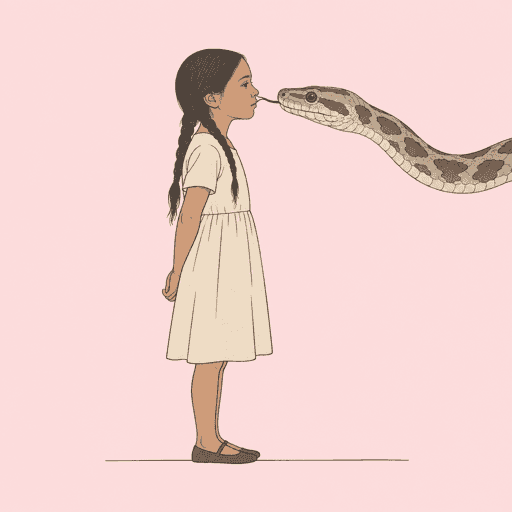
“The touch of its tongue had been dry and lighter than the stroke of a sable paintbrush. Yet the touch left me with a vast feeling I have yet to name. It was more than a sensation. It was as though I had been chosen—marked for wisdom or maybe sorrow.”
(Story 1, Page 14)
This passage captures the story’s central, surreal event, personifying the snake’s touch as a quasi-mystical “kiss.” This formative memory makes the narrator feel “chosen,” and the ambiguity between “wisdom or maybe sorrow” heightens the mystery around the snake’s intentions and motivations, making it feel more complex than an ordinary predator.
“It wasn’t the loss of the actual dresses, she thought, it was their squalid disintegration that was so disturbing. Memories of her marriages had been dry and controlled. When she moved the hangers, she released a cloud of choking spores—as if she’d exposed a dead thing, a moldy growing thing moving with avidly feeding alien lives.”
(Story 2, Page 23)
This quote connects the story’s central symbol to the theme of the persistence of tactile memory. The “squalid disintegration” of the dresses forces a visceral confrontation with the past that abstract memory does not. Erdrich’s simile comparing the dresses to “a dead thing” underscores their exhumed quality, driving the idea that they have been ravaged by time even as Dora’s memories remain intact.
“Perhaps it was strange that, of her loves, the hopeless alcoholic would be the one she still mourned, and somehow couldn’t live without.”
(Story 2, Page 42)
This passage reveals a complex pathos around Dora’s history of love, subverting expectations by identifying the “hopeless alcoholic” as the most deeply mourned partner. Rather than mourn a lost ideal, her grief is for a flawed, tangible person with whom she was “real,” suggesting that the gravest connections are found in shared, messy humanity.
“The chill in Ivek was far deeper than the fire could touch. The reality of the cold world beneath the ice was stronger than the warmth of the school. He turned away from the stove so the children wouldn’t see his tears. What was up and what was down?”
(Story 3, Page 52)
Erdrich uses metaphor to articulate the depth of Ivek’s psychological trauma, portraying a chill that is internal and untouchable by physical warmth. The juxtaposition between the perceived reality of his hallucination and the tangible safety of the school illustrates how memory can become more powerful than the present moment.
“When half of you is gone, the half left behind begins its long descent into a cold strange barn. No matter how warm you get you are never warm and no matter how much you eat you are never full. You are out of harness but somehow pulling the entire weight.”
(Story 4, Page 68)
The narrative voice shifts to an omniscient, lyrical perspective to describe the surviving horse’s grief for its mother. Erdrich uses an extended metaphor of cold, hunger, and weight to articulate a deep, non-verbal experience of loss, fully realizing the theme of Human Intimacy With the Nonhuman by treating the animal’s emotional state with deep seriousness.
“‘Love of my days.’
He had said it to her then and he said it to her now. Someone’s boots squeaked on the snow. Budack loomed over them, his revolver out. Kneeling beside Timble, Beatril grasped his hand and said, ‘Don’t mind him.’”
(Story 4, Page 69)
This quote reveals the story’s title and Timble’s ultimate motivation. His final moments are of a transcendent memory of his lost love, Beatril, which blurs with reality as he dies. This ending provides pathos for his character, as well as a tragic, humanizing context for his crimes, suggesting his desperate flight was an unconscious attempt to return to this moment of grace.
“Seven corporations control the afterlife, and many people spend their lives amassing the money to upload into the best. Others, like me, assume they will need a scholarship and pile up experience.”
(Story 5, Page 73)
This premise establishes a dystopian, capitalist framework where salvation is a tiered service run by corporations. By introducing metaphorical concepts like “scholarships” and “service providers,” Erdrich embeds the theme of The Commodification of Disembodied Life in established market forces, allowing the reader to pick up the features of this speculative universe by way of comparing them to their real-world equivalents.
“I used the sky as my masking image—you could not get through it to the bad thing that had happened. The sky was my protection. I could pass through years of sky, a slideshow of sky, endless mental snapshots.”
(Story 5, Page 74)
This passage depicts memory as both a shield and a form of currency essential for survival in a world of mental surveillance. Erdrich uses the sky as an expansive demonstration of Bernadette’s psychic capabilities. This metaphor is paradoxical, given that the prevailing feature of the sky is its transparency. Bernadette is using the sky as an impenetrable defense mechanism built from sensory detail, showing memory’s value and power in this highly technologized world.
“I do not have to say goodbye to my eyes. I’ll still see. And in fact I will feel the feelings of all parts of my body. I will feel the eidetic past. But the broken body I am leaving behind will be recycled for parts and then sold for remaining mineral content.”
(Story 5, Page 77)
This quote highlights the central paradox of uploading: Consciousness and sensory memory persist even as the physical body is discarded and commodified. Bernadette’s assertion that she will still “feel the feelings” of her body emphasizes the lasting power of tactile memory, contrasting the ephemeral nature of flesh with immortal, eidetic sensation.
“All at once, I realized that he knew what was going to happen. He’d seen the bridge in advance. There was the hint of marveling thrill in his eyes.”
(Story 7, Page 112)
This moment marks the story’s turning point, where a photograph confirms the narrator’s abstract fears about her husband’s malevolence. The image cements the husband’s characterization as an antagonist and frames the remainder of the story as a conflict over the narrator’s survival.
“My hat was rattling and vibrating now, but not from fear, for the sound was gathering into a noise of salvation close to ecstasy, close to an immortal idiocy, a fevered reality swirling with life.”
(Story 7, Page 116)
In the story’s conclusion, the symbolic function of the Borsalino hat transforms. Previously, its rattling snakeskin signaled external danger, but here it vibrates with an internal energy of survival and freedom. The onomatopoeia of the rattle is an ecstatic affirmation of life, showing the narrator has reclaimed her power.
“‘I don’t know, Mom,’ said Crimson. ‘Is this worse than active shooter drills? Maybe we’re playing for practice. How do you think you’d deal with it? You guys can’t know. Who or what comes down the hall? Through your classroom door? We’re scared.’”
(Story 8, Page 125)
This quote serves as the story’s thematic climax, articulating the deep generational divide in experiencing fear. Through a series of rhetorical questions, Crimson confronts her mother with the ambient terror of school shootings, a reality Maxine’s generation did not face.
“Ours is an isolated little community in Wisconsin or Michigan or Minnesota, it doesn’t matter. We’re near water and near Canada.”
(Story 9, Page 131)
The narrator’s deliberate vagueness about the community’s specific state suggests its problems are representative of many isolated, often Indigenous communities. This placelessness creates a universal quality, while the specific geographic detail of being near Canada serves as important foreshadowing for the cross-border crime plot that drives the narrative.
“‘Now hold my hand, sis.’
‘Oh fuck, what?’
‘That little girl is Delvin’s daughter.’
After a while, I said, ‘So what else don’t I know?’
‘Um,’ said Raf, ‘that she’s coming to live with you?’”
(Story 9, Page 139)
This sequence of dialogue delivers two life-altering revelations with stark brevity, mirroring the shock the narrator experiences. The clipped, direct pacing accelerates the plot and escalates the personal stakes of the criminal entanglement. The rapid progression from a distant crime to an immediate familial responsibility fundamentally alters the narrator’s life and the story’s trajectory.
“It’s Raf you should worry about, Mom. You should worry about your brother. It’s too fucking late for your son.”
(Story 9, Page 141)
Delvin’s desperate confession shatters his mother’s remaining sense of security, revealing that the law enforcement she trusts is complicit in a larger scheme of crime and danger. This key twist emphasizes Carleen’s isolation and the inescapable nature of her predicament. The line inverts the roles of protector and threat, showing the deep-seated corruption that has ensnared her son.
“The bathroom in my apartment is a special project—cheap black and white linoleum tiles for the floor and up along the bathtub wall. Each white tile bears a poem copied out by hand, by me, using a permanent marker.”
(Story 10, Page 157)
This description establishes the narrator’s unique character and the central symbol of the story: a floor covered in handwritten poetry. This act of preserving literature in such a mundane and vulnerable location deepens his characterization, highlighting his devotion to art in the face of a transient life.
“Yes, when I touched her, the cat’s flesh grew cold and dense. She became an inert statue and there was nothing I could do to bring back the soft magic of her intrinsic catness. I tried to shake off a sense of being judged as a man.”
(Story 10, Page 163)
The physical transformation of the cat under the narrator’s touch is a potent metaphor for the unbridgeable gap between the domestic and the wild. The cat’s flesh growing “cold and dense” signifies its complete psychological withdrawal, an absolute rejection of his attempt at intimacy. Erdrich emphasizes their distance further by personifying the cat, making it feel as though it is judging the narrator.
“From the far end of the second-floor hallway came the powerful rip of my mother-in-law’s rough-cut saw. From below, on the living room’s foldout couches, the intermittent thrum of welders’ torches—a wild hissing as the sisters’ noses sparked and soldered invisible objects. Beside me, Elida’s finishing touch: The high-pitched burr of a polisher perfecting a metal surface.”
(Story 11, Page 173)
This passage establishes the story’s central conceit through elaborate metaphor and onomatopoeia, transforming snoring into a mechanical symphony. By likening the sounds to a “rough-cut saw,” “welders’ torches,” and a “polisher,” the narrator frames a biological annoyance as a powerful, industrial act. This imagery highlights his hyper-awareness and imaginative interpretation of sound.
“The orderly, mechanical regularity of the metalworking shop had been abandoned. Now it was more like a pack of wolves snarling over a kill. I closed my eyes. On my mental screen I saw lions driving the wolves—or hyenas, maybe—into the veld.”
(Story 11, Page 184)
This quote is an important shift in the narrator’s perception, replacing his earlier industrial metaphor with a primal, animalistic one. The snores have become the sound of “wolves snarling over a kill.” This transformation reflects his emotional journey toward accepting his wife’s family, reinterpreting their “flaw” as a powerful, natural force.
“Marty seemed to enjoy hating everything around him, giving a sardonic twist to repeating the orders. ‘Large bucket’ became ‘Laaahge. Fuhhk. Id.’ It was a very weak joke, if it even rose to the level of a joke. But I always laughed because then he’d use what seemed his last bit of energy to pretend-surf over the slick tiles to the row of pressure cookers.”
(Story 12, Page 189)
This detailed behavioral description establishes Marty as a figure of weary rebellion. His sardonic wordplay, transforming a corporate phrase into a profane utterance, shows a small but significant act of resistance against the dehumanizing nature of his job. Through Marty, the narrator learns about a form of principled opposition that she will later adopt herself.
“I was gratified by the Colonel’s popularity because at school I was classified as a weirdo. I hated eating alone, which I did at lunch most days because I was a rung below the unpopular group. I was unpopular all by myself. But Mr. Ponath gave me hope.”
(Story 12, Page 191)
This passage establishes a direct parallel between the narrator and Mr. Ponath, linking them through their shared status as social outcasts. The narrator’s identification with him reveals her deep sense of alienation and her yearning for connection. Mr. Ponath’s ability to turn his “weirdness” into a source of community offers the narrator a model for navigating her own isolation.
“They say revenge is a dish best served cold, but it wasn’t true in the case of the drumstick. One thing I knew. Someday I’d get a letter from an extraordinary place. The letter would be in Mr. Ponath’s handwriting. And it would be signed Amelia.”
(Story 12, Page 211)
This concluding passage upends a common cliché (“revenge is a dish best served cold”) to deliver the story’s central revelation about identity and justice. The narrator’s final realization lends credence to the idea that Mr. Ponath and Amelia were one, transforming a story of quiet friendship into a triumphant tale of elaborate revenge. The expected letter signed “Amelia” symbolizes the narrator’s full acceptance of Mr. Ponath’s complex, dual identity.
“One night, as she lay in the hot water, she became acutely aware of the stone. The smooth, empty scoops in its face seemed deeply interested in her. A gentle, thrilling ripple spread through her body. After a while, she took the stone into the water with her and held it on her chest, then slid it down her body until it rested, heavily, between her legs.”
(Story 13, Page 270)
This moment is a significant evolution in the protagonist’s relationship with the stone, moving it from psychological comfort to physical intimacy. The personification of the stone, which seems “deeply interested in her,” facilitates her sensual awakening outside of a human relationship. This scene explores the theme of Human Intimacy With the Nonhuman in a startlingly physical manner.
“A stone is a thought that the earth develops over inhuman time. It is a living thing to some cultures and a dead thing to others. This one had been called nimishoomis, or ‘my grandfather,’ and other names, too.”
(Story 13, Page 220)
This authorial intrusion widens the story’s perspective, framing the stone within deep geological and cultural time. The text contrasts a scientific definition of basalt with the Anishinaabe word for grandfather (“nimishoomis”), suggesting the object possesses a significance beyond its current state. This history elevates the stone from a simple object to a vessel of memory and spirit.

Unlock every key quote and its meaning
Get 25 quotes with page numbers and clear analysis to help you reference, write, and discuss with confidence.
- Cite quotes accurately with exact page numbers
- Understand what each quote really means
- Strengthen your analysis in essays or discussions
Related Titles
By Louise Erdrich














Featured Collections
Books on Justice & Injustice
View Collection
Challenging Authority
View Collection
Childhood & Youth
View Collection
Coming-of-Age Journeys
View Collection
Earth Day
View Collection
Fear
View Collection
Indigenous People's Literature
View Collection
Memory
View Collection
Mortality & Death
View Collection
National Book Awards Winners & Finalists
View Collection
Nature Versus Nurture
View Collection
Power
View Collection
Revenge
View Collection
Safety & Danger
View Collection