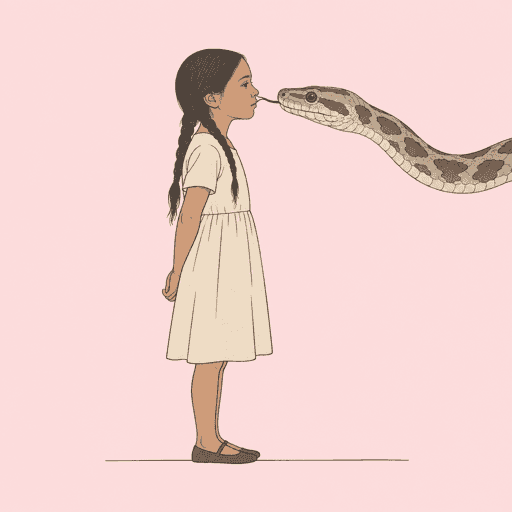
Python's Kiss
A modern alternative to SparkNotes and CliffsNotes, SuperSummary offers high-quality Study Guides with detailed chapter summaries and analysis of major themes, characters, and more.
Summaries & Analyses
Quizzes
NEWReading Tools
Story 10Chapter Summaries & Analyses
Content Warning: This section of the guide includes discussion of animal cruelty and graphic violence.
Story 10 Summary: “The Feral Troubadour”
The narrator, an unemployed poet, lives in a converted attic where he has written poems in permanent marker on his bathroom tiles. Inspired by what he perceives to be a divine vision cast by a tangle of bunting, the narrator resolves to change his life, caring for something small. He sets out a trap to capture a local feral tabby cat.
One evening, while waiting for the trap to spring, he is interrupted by a troubadour serenading his vacationing downstairs neighbor’s window, a woman the narrator once dated and whose company he yearns for. The trap snaps shut simultaneously as the narrator confronts the man, who urinates on the lawn before leaving.
The narrator confines the terrified cat to his “poetry bathroom,” where he makes unsuccessful attempts to tame her. A few days later, two police officers apprehend the troubadour on the lawn and question him about recent burglaries in the neighborhood. Despite his anger at the man, the narrator provides an alibi, stating the troubadour was there singing five nights ago at the time of a break-in. In a brief shift of perspective, the troubadour reveals the narrator is off by a day and plans to return to rob the house.
Frustrated with his failure to tame the cat, the narrator desperately tries to have it rehomed. Soon after, a kind woman responds to the narrator’s online plea and agrees to adopt the cat. That night, the narrator is awakened by the police. They find the troubadour screaming on the rooftop of the house, his fingers caught in the upstairs bathroom window sash. He claims that while attempting to break in, the feral cat attacked him and caused the window sash to slam down on his hands.
After firefighters rescue the thief and the police take him into custody, the woman arrives and takes the cat from the narrator. The narrator later speaks with the female police officer, who confirms the troubadour’s fingers were entirely saved and that he was indeed the burglar. When the narrator asks her for a drink, she says she will think about it and calls him “cute.” The narrator cleans his bathroom, feeling content with his modest life and his role as a caretaker for overlooked creatures.
Story 10 Analysis
The narrator’s “special project” of copying poems by hand onto cheap linoleum tiles establishes his character as a melancholic romantic, someone who expresses his admiration for the poetic form in tedious ways that resemble suffering. Within this unconventional creative act, Erdrich also reveals the privacy and vulnerability that define the narrator’s character. The very medium of his art mirrors his modest self-perception and his quiet rebellion against conventional measures of success; he creates beauty in a disposable space and takes pride in the fact that he “waste[s] no trees” (158). This domestic sanctuary, with its “closet stuffed with savage mementos” (156), becomes a site for The Persistence of Tactile Memory, where literature is a tangible presence subject to the messiness of life. The poems are physically vulnerable to “grubby paw prints” and the “penetrating reek of cat” (158), turning the act of reading and memorizing into a lived, sensory experience. The poetry tiles are proof of an identity built on private acts of care and creation rather than public acclaim, grounding his character in a space that is as impermanent and idiosyncratic as he is.
The simultaneous sounds of the troubadour’s mourned guitar chord and the snapping metal of the cat trap crystallize the story’s central conflict over territory, masculinity, and social boundaries. The troubadour embodies an invasive, performative masculinity, using Bruce Springsteen’s “undeniably sexy song” to stake a claim on a woman and a space the narrator also desires (159). His public serenade and subsequent urination on the lawn are aggressive, territorial acts that directly challenge the narrator, who admits he would “have trouble taking him” in a physical fight (159). In contrast, the narrator’s mode of being is introverted and nurturing; he is a man who lolls in a bathtub memorizing verse and traps animals to save them from “misery or doom” (157). The confrontation forces him from his contemplative solitude into a direct, if awkward, defense of his home. His decision to later provide a flawed alibi for his rival, despite his anger, reveals a complex moral calculus. It suggests an underlying empathy for a man who is also “underemployed” and adrift, even as it emphasizes the narrator’s deep discomfort with direct, aggressive conflict.
The narrator’s fraught attempts to domesticate the feral tabby cat become a deep exploration of Human Intimacy With the Nonhuman. He sees the tabby as a creature to be rescued, yet the animal serves primarily as a mirror for his own feelings of alienation. He feels he has “vanished from honorable view and am ghosting along here in my cluttered rooms” (161), an existence as marginal as the feral cat’s. His taming efforts are therefore an attempt to impose order on a wildness he recognizes in himself. The cat’s visceral resistance to his touch is a powerful rebuke to his control. He feels “judged as a man” by the creature (163), whose untamable spirit challenges his competence and forces him to confront the limits of his empathy. Their relationship is a complex negotiation of fear, projection, and shared otherness, culminating in the cat’s accidental act of heroism. In causing the window to slam on the troubadour’s fingers, the cat subverts the narrator’s role as protector and becomes a chaotic agent of justice, defending the domestic space more effectively than he could.
The brief shift in perspective to the troubadour’s thoughts introduces a layer of dramatic irony that reshapes the narrative. After the narrator provides a merciful alibi, the troubadour internally scoffs, “What fools. And more fool he! […] For of course he was off by a whole day and night” (165). This structural choice is key, revealing the troubadour as a calculating predator. The narrator’s act of kindness is exposed as naivete, a misreading of a genuine threat born from his own introspective and non-confrontational nature. This moment temporarily transforms the story’s tone from quirky domestic realism into something more akin to a thriller, heightening the stakes of the impending break-in. It critically destabilizes the reader’s trust in the narrator’s judgment, suggesting that his gentle world is dangerously porous and that his remove from “honorable view” leaves him vulnerable to deceptions he cannot perceive. The intrusion highlights the fragility of his self-contained existence.
The story concludes with the narrator achieving a quiet state of self-acceptance, reframing his isolation as a universal condition. After the chaos of the break-in and the cat’s departure, his ritualistic cleaning of the poetry bathroom becomes an act of restoring order on his own terms. By “tenderly wiping around the text of each poem” (168), he is affirming its value. This internal resolution is bolstered by external validation: a potential date with the female police officer who shows an attraction to him, which pulls him toward social connection. He realizes that the recurring feeling of being “malformed or broken, foolish” might be the very thing that constitutes “the true human connection” (169), the shared vulnerability that makes poetry possible.

Get in-depth, chapter-by-chapter summaries and analysis from our literary experts.
- Grasp challenging concepts with clear, comprehensive explanations
- Revisit key plot points and ideas without rereading the book
- Share impressive insights in classes and book clubs
Related Titles
By Louise Erdrich

















Featured Collections
Books on Justice & Injustice
View Collection
Challenging Authority
View Collection
Childhood & Youth
View Collection
Coming-of-Age Journeys
View Collection
Earth Day
View Collection
Fear
View Collection
Indigenous People's Literature
View Collection
Memory
View Collection
Mortality & Death
View Collection
National Book Awards Winners & Finalists
View Collection
Nature Versus Nurture
View Collection
Power
View Collection
Revenge
View Collection
Safety & Danger
View Collection