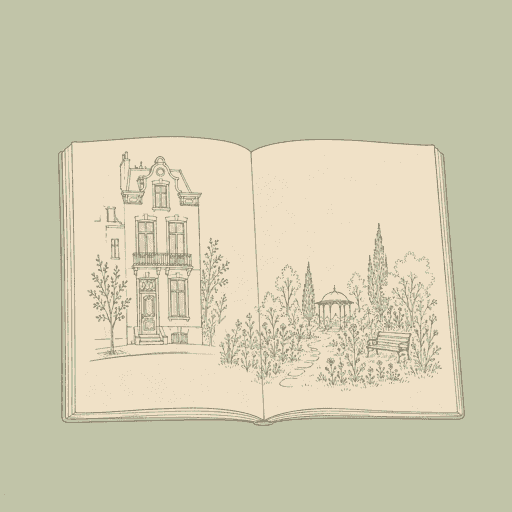
33 Place Brugmann
A modern alternative to SparkNotes and CliffsNotes, SuperSummary offers high-quality Study Guides with detailed chapter summaries and analysis of major themes, characters, and more.
Summaries & Analyses
Quizzes
NEWReading Tools
Background
Content Warning: This section of the guide includes discussion of religious discrimination, graphic violence, and death.
Historical Context: The 1943 Avenue Louise Gestapo Attack
During the German occupation of Belgium in World War II, the Gestapo established its headquarters at 453 Avenue Louise in Brussels. This location became a notorious site of interrogation and torture, instilling fear in the local population. On January 20, 1943, a Belgian aristocrat and Royal Air Force (RAF) pilot, Baron Jean de Sélys Longchamps, conducted an unauthorized solo attack on the building. After completing an approved mission near Ghent, he flew his Hawker Typhoon fighter plane at rooftop level through Brussels and strafed the facade of the headquarters with cannon fire. The attack officially killed four German officers and wounded several others, though reports indicate that up to 30 people were killed in the attack (“F/Lt Baron Jean de Selys Longchamps’ Attack on Secret Police HQ and a Hectic Day for No.609 Squadron.” History of Manston Airfield, 12 Feb. 2026.) Though officially demoted for his unsanctioned actions, de Sélys Longchamps was celebrated as a hero of the Belgian resistance and later awarded the Distinguished Flying Cross.
This real-world act of defiance serves as the novel’s destructive climax. In the final chapters, Charlotte learns that her father, Francois, was being held for questioning inside the building when it was bombed. The historical attack, framed in the novel as a moment of heroic retribution by onlookers who shout, “Bold Longchamps!” (339), becomes the source of Charlotte’s deepest personal tragedy. This intersection of a public act of war and private loss emphasizes the chaotic and often indiscriminate nature of wartime violence, where heroic deeds can have unforeseen, destructive consequences for innocent individuals.
Historical Context: The Manod Quarry Art Evacuation
As the threat of German bombing raids intensified during World War II, British authorities sought secure locations to protect the nation’s priceless art collections. An initial proposal to move art to Canada was vetoed by Prime Minister Winston Churchill, who reportedly declared, “Hide them in caves and cellars, but not one picture shall leave this island” (“Safeguarding National Treasures.” The National Gallery). Consequently, a remote, disused slate quarry at Manod Mawr, near Blaenau Ffestiniog in North Wales, was selected to house the treasures of London’s National Gallery.
To make the site suitable, engineers used explosives to widen the entrance to accommodate the largest canvases and constructed several climate-controlled brick “bungalows” deep within the caverns to protect the artworks from humidity and temperature fluctuations. Beginning in the summer of 1941, the entire collection was secretly transported to this subterranean fortress, where it remained for four years.
This elaborate historical preservation effort is directly mirrored in Leo Raphaël’s storyline. A Jewish art dealer, Leo works with a cousin at a London museum to safeguard paintings from the Nazis. His secret project involves preparing a “slate quarry” in Wales, where they “built brick bungalows down below that will hold temperatures steady and humidity down” to create an “underground museum” (129, 128). By grounding Leo’s actions in the real-world Manod Quarry operation, the novel authenticates his personal mission, portraying it as part of a larger, desperate struggle to preserve cultural heritage and identity in the face of annihilation.
Philosophical Context: Ludwig Wittgenstein, Alan Turing, and the Tractatus
In 1921, the philosopher Ludwig Wittgenstein published a short but highly influential book called the Tractatus Logico-Philosophicus. In it, he argued that language works like a picture: Once a proposition is known, it immediately conveys the logical form of the reality it supposedly represents, the same way that a picture conveys the visual form of the reality it represents as soon as it is seen. However, a proposition is only meaningful if it describes something that actually exists in the world. That statement must therefore be compared to reality to determine its truth value. For Wittgenstein, anything that could not be pictured this way, including many questions about ethics, emotion, or meaning, simply could not be talked about clearly. As he wrote in the book’s own famous closing proposition, “whereof one cannot speak, thereof one must be silent” (Wittgenstein, Ludwig. Tractatus Logico-Philosophicus. Kegan Paul, Trench, Trubner & Co., 1922).
Wittgenstein later extended this idea to mathematics. He argued that a contradiction inside a purely mathematical system was harmless, since the system does not describe or “picture” the real world the way an ordinary sentence does; it is simply a set of rules. In 1939, the mathematician Alan Turing attended a series of Wittgenstein’s lectures at Cambridge and pushed back on this idea. Turing argued that logical contradictions were not harmless: if one crept into the mathematics used to build something like a bridge, “the real harm will not come [from contradiction] unless there is an application, in which case a bridge may fall down” (Wittgenstein, Ludwig. Wittgenstein’s Lectures on the Foundations of Mathematics. University of Chicago Press, 1989). Wittgenstein disagreed, treating such contradictions as puzzles confined to language rather than real dangers. This assertion emphasized the need to compare statements to reality.
This debate shapes 33 Place Brugmann, which opens with a line from Wittgenstein and returns to his ideas throughout. Julian, himself a Cambridge math student, describes the actual Wittgenstein-Turing argument to Charlotte. Her father, Francois, and her husband, Philippe, both turn to the Tractatus, hoping its rules for clear thinking can make sense of a senseless war. Charlotte, who has colorblindness, has a different relationship to visible “facts,” and she questions Wittgenstein’s claim that “objects are colorless” but have color as part of their form (242). Through these responses, the novel asks whether logic alone can capture the full truth of lived experience, a question that grows more urgent as the world around the characters stops making rational sense and they must rely on less rational responses for survival, like hope.

Get in-depth, chapter-by-chapter summaries and analysis from our literary experts.
- Grasp challenging concepts with clear, comprehensive explanations
- Revisit key plot points and ideas without rereading the book
- Share impressive insights in classes and book clubs