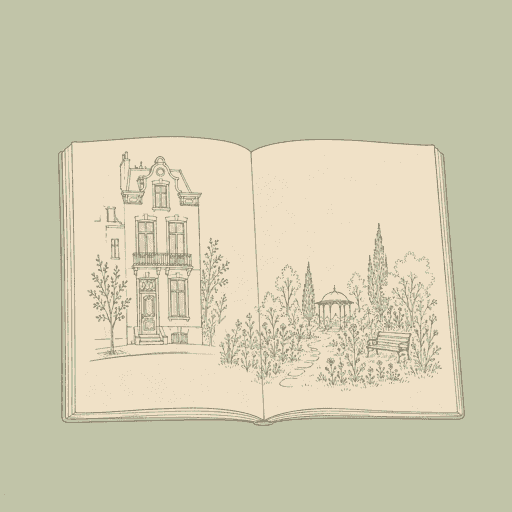
33 Place Brugmann
A modern alternative to SparkNotes and CliffsNotes, SuperSummary offers high-quality Study Guides with detailed chapter summaries and analysis of major themes, characters, and more.
Summaries & Analyses
Quizzes
NEWReading Tools
Important Quotes
Content Warning: This section of the guide includes discussion of animal cruelty, animal death, cursing, religious discrimination, graphic violence, ableism, illness, and death.
“We hear every sound in this building. Through thin, rippled window glass, gaps between frames and doors, crude holes around pipes and wires, up and down the broad echoing stone staircase, up and down the narrow echoing elevator shaft, every sound travels.”
(Part 1, Chapter 1, Page 3)
This description establishes the apartment building at 33 Place Brugmann as a central symbol. The permeable quality of the structure, where no sound is private, mirrors the interconnected lives of its residents, making total privacy impossible. The apartment at the center of the novel is a microcosm of a society where secrets are impossible to keep, foreshadowing future betrayals.
“Charlotte was the closest I’ve had to a daughter. She was my angel. And I will be hers.”
(Part 1, Chapter 2, Page 22)
Masha’s declarative statement establishes her deep, maternal bond with Charlotte and her role as a fierce protector. The use of the metaphor comparing Charlotte to her “angel” elevates their connection beyond mere friendship, introducing a mystical, devotional quality to their relationship. This dynamic informs the actions Masha will later take on Charlotte’s behalf.
“I look around and see animals dressed in skins of their kind. I look back at Mats. There’s no fear in those pig eyes.”
(Part 1, Chapter 3, Page 32)
In this passage, Leo deploys a surreal metaphor that compares the people around him to animals, suggesting that their survival instinct overpowers their capacity to be human toward each other. This moment of psychological horror strips away the veneer of civilization, revealing the predatory, animalistic nature of collaborators like Mats. The imagery illustrates the moral decay that Leo perceives just beneath society’s surface.
“‘Never underestimate the peculiarity of the common man,’ as my departed daddy used to say.”
(Part 1, Chapter 5, Page 43)
Miss Hobert’s recollection of her father’s words reveals her own worldview and foreshadows the danger posed by ordinary people during the occupation. The aphorism ironically highlights how the petty actions of bystanders, driven by suspicion or self-interest, can have deadly consequences. It directly addresses the theme of The Cost of Passive Complicity.
“No one sees anything the same way. When we stop trying to understand how others see the world, when we lose our compassion, our empathy, we become animals. Worse than animals.”
(Part 1, Chapter 6, Page 55)
Spoken by the headmistress about the cruelty of the children, this dialogue explicitly states a central theme regarding The Limits of Objective Truth. It argues that humanity is defined by empathy and the effort to comprehend subjective realities. Once again, Austen deploys the metaphor of animals to emphasize the loss of humanity during the war. This statement is therefore a moral thesis for the entire novel.
“I have no intention of reading that annoying little book. Men invented philosophy to explain how the world they see in black and white could be so gray. I don’t need philosophy to understand the world as I have always seen it.”
(Part 1, Chapter 7, Page 82)
Charlotte’s internal monologue rejects the abstract intellectualism of Wittgenstein’s philosophy embraced by the men in her life. Her statement champions her own direct, intuitive experience as a valid way of knowing the world. This perspective reinforces the novel’s theme that truth is subjective, rather than being defined by authoritative voices like philosophers.
“Perhaps I was imagining it, but I could just make out the shape of a flaxen creature. I would swear it was a lioness stretched out on the pavement.”
(Part 1, Chapter 9, Page 94)
Masha’s vision introduces the recurring symbol of the lioness. This mystical element appears at a moment of vulnerability and danger, suggesting a supernatural or spiritual force of protection that exists outside the rational world. The creature’s uncertain shape lends ambiguity to its reality, which becomes a recurring facet of its appearances throughout the novel. The lioness thus represents an interior state that cannot be easily explained away by mere science or language.
“The occupation of Brussels was immediate, but the constraints—the impositions, the curfews, the ostracizing, the marking, the bans, the roundups, the deportations, the murders—these happened so gradually they might be called cunning, for just as you got used to one thing, there was another. It was always happening to someone else, until it wasn’t, and by then it was too late.”
(Part 2, Chapter 10, Page 103)
This passage uses asyndeton to list the escalating horrors of the occupation, mirroring their overwhelming and gradual imposition. The observation captures the psychological mechanism of normalization that enables atrocities, directly stating the novel’s theme of the cost of passive complicity. It shows how incremental dehumanization can occur without a single, decisive moment of resistance.
“How do you move beyond baskets of hands? You don’t. They’re rigid, those hands, and the Congo’s damp enough that they don’t dry out. They rot. And smell. I got the hell out, went from war to war, bad to worse.”
(Part 2, Chapter 11, Page 116)
Colonel Warlemont’s memory of the atrocities in the Congo provides important backstory, explaining his moral resolve to join the resistance. The visceral, grotesque imagery of the rotting hands is a personal symbol of man’s capacity for evil. This passage thus reveals how his worldview is shaped by unspeakable horror, which he sees again with the Nazi occupation.
“[B]ecause what the Greeks understand and we don’t is that so long as the idea lives and the monument that embodies it stands, a lot of people can die, and a civilization will carry on.”
(Part 2, Chapter 12, Page 123)
Leo Raphaël’s dream about the Parthenon is a direct articulation of the theme of Art as a Repository of Humanity. Austen uses metonymy to allow the monument to represent the lasting ideas of a culture, which are under threat of extinction. This philosophical justification fuels Leo’s mission to save artworks from destruction
“You see how wrong it is? There’s no such thing as beating odds, not really. We can’t beat them. We’re part of them. What happens to us will become part of the computation.”
(Part 2, Chapter 13, Page 134)
Julian’s reflection on Bayesian probabilities applies his mathematical mind to the grim reality of war and exposes its limits. This passage highlights the limits of objective truth by contrasting the cold, statistical facts with the human need for hope and morale. His refusal to share the odds with his crew is a compassionate lie, a protective act against a despairing reality. Even then, his worldview prevents him from holding out hope for the chance of survival, which informs the latter part of his character arc.
“This is when I vomit. Without warning, it spews out of me, hitting his wool vest, running down his trousers, and spattering his dusty shoes. Unintentional. But also, I mean to do it.”
(Part 2, Chapter 16, Page 160)
Charlotte’s involuntary act of vomiting becomes a weapon against her manager, DeDecker. This moment merges the physical reality of her pregnancy with an act of defiance. The paradox of her action being both “unintentional” and intentional showcases her will to survive, using her body and its perceived weakness as a source of strength.
“Charlotte picked up the red pencil, my red pencil, and looked at it, then she put it down and picked up the yellow pencil, my yellow pencil. And she drew a perfect cube with that yellow pencil, so pale against the white paper you could barely see it.”
(Part 2, Chapter 17, Page 176)
This memory reveals both Dirk’s early cruelty and Charlotte’s quiet integrity. Her choice to draw with the “wrong” color is an assertion of her visual perception of reality and thus a reflection on the limits of objective truth. Dirk only sees the color as wrong because he mistakenly believes there is only one way to see reality; Elisabeth’s action represents rebellion against this notion, which informs Dirk’s initial hostility toward her.
“‘Of who we are. As people.’
‘You’re beginning to sound like an Englishman.’”
(Part 2, Chapter 19, Page 191)
In this exchange between Julian and his father, the novel foregrounds the theme of art as a repository of humanity. Leo’s project of displaying a single painting in the National Gallery amidst the Blitz is an act of cultural and psychological resistance. Julian’s observation uses simile to emphasize the difference between Leo and the typical worldview of an Englishman. This signals the impact that their flight from Brussels has had on his character.
“The truth is a dangerous thing, and the people who talk most about it, in my experience, like it least. Miss Hobert, for example, loves truth.”
(Part 2, Chapter 20, Page 196)
This quote establishes Colonel Warlemont’s cynical worldview, which contrasts sharply with the naive moralizing of his neighbor, Miss Hobert. It speaks to the theme of the limits of objective truth by suggesting that in the morally compromised world of the occupation, “truth” is often a manipulated or weaponized concept.
“Life is a dream. You wake up long enough to know it’s a dream…just before you die.”
(Part 2, Chapter 23, Page 221)
Delivered from beyond the grave, Masha’s final thought encapsulates her tragic fate and the novel’s philosophical undertones. This line, which metaphorically compares life to a dream state, suggests a reality beyond the brutal facts of her murder, touching upon a mystical perception of life and death. It is only in her death that she can grasp the truths she could not access in her life.
“He never smiles at me, does he? Or at anyone else. What can I say? Everyone likes a present.”
(Part 2, Chapter 24, Page 222)
Miss Hobert’s internal monologue reveals her petty and self-centered nature, showing the cost of passive complicity. Her jealousy over the hat Charlotte gives the newsboy emphasizes how small grievances and a focus on personal slights can blind characters to the larger human drama around them.
“In a war of information, the best weapon is better information.”
(Part 2, Chapter 27, Page 255)
This aphoristic quote reveals Dirk DeBaerre’s core philosophy and modus operandi. He navigates the occupation as an information broker, believing that information can function as both a weapon and as currency. This statement justifies his morally ambiguous activities, like attending VNV meetings and spying, framing them as part of a necessary survival strategy where knowledge means the difference between life and death.
“It’s not a collective hallucination, Papa, it’s rage, and it possesses those for whom acting or not acting are equally murderous and suicidal.”
(Part 2, Chapter 28, Page 264)
After his plane is shot down, Julian refutes his father’s philosophical idea of “collective dreams,” replacing it with the visceral reality of rage. The phrasing “equally murderous and suicidal” captures the impossible moral calculus of war, where every choice leads to destruction. This raw emotional truth grounds the novel’s more abstract intellectual concerns in the lived experience of trauma.
“But it’s emptying out now, my picture is. All the people in it are becoming shadows.”
(Part 2, Chapter 30, Page 273)
Charlotte uses the metaphor of a painting to describe her life, directly linking to the theme of art as a repository of humanity. The image of her life’s “picture” emptying and its figures becoming “shadows” illustrates the dehumanizing effect of war, which erases the vivid connections and memories that constitute a person’s world.
“What mother wants to give birth to a son, to feel the slippery little eel, compressed bones, wrinkled skin, slide out of her, to nurse him into human form, to love and teach and feed him—only for him to be killed? By men. It’s all men.”
(Part 2, Chapter 31, Page 280)
Upon hearing that Julian is missing, his mother Sophia expresses a deep grief that she relates to her gender. Austen presents a compact vision of motherhood in these few lines, contrasting the visceral description of childbirth with the destructive act of war. By attributing war to men, Sophia’s declaration underscores the failure of men to inhabit the qualities gleaned from the life-giving, nurturing work of women.
“I trust people to be themselves. I trust them to cut off my testicles. I trust Piet to stab me in the neck. I trust Hobert to push me down the stairs. As for me? I don’t trust myself. Not one bit.”
(Part 2, Chapter 32, Page 292)
This quote encapsulates Dirk’s deep cynicism and self-awareness, forged by the treacherous environment of the occupation. His “trust” is a dark expectation of others’ worst impulses. His final admission of self-distrust reveals his moral ambiguity and positions him as a dangerously unpredictable character, capable of both betrayal and heroism.
“Father’s giggling again. He unties and reties his shoes, struggling mightily to suppress the laughter. And he’s smiling as he gets up from the table.”
(Part 2, Chapter 37, Page 315)
Facing arrest by the SS, Francois’s laughter is an ironic act of psychological resistance. This moment defies the expected response of fear, suggesting he perceives the situation through a different philosophical lens. By laughing at the Nazis, he acknowledges the absurdity of their rigid and baseless authority. His reaction subverts the power dynamic of the encounter.
“Mr. Christophe Wolters, a former partner in Mr. Sauvin’s defunct architecture firm, claims that Mr. Sauvin is a Jewish sympathizer who actively resisted carrying out government edicts regarding Jews.”
(Part 2, Chapter 38, Page 319)
This accusation, recorded in a dry, bureaucratic report, exemplifies how personal history and professional rivalries were weaponized during the occupation. The detached tone of the record reduces and dehumanizes Francois, making it appear as though his former colleague had a right to accuse him of crimes by virtue of his legal and moral imperative. Austen relies on the reader to know otherwise, understanding what the official record fails to report on Francois and his moral perspective.
“I shot the fucking dog, and that’s all I’ll say about the matter.”
(Part 2, Chapter 40, Page 323)
As the entirety of Ivo Van Cauter’s chapter, this single, blunt statement reveals his brutal and remorseless nature. The casual profanity and refusal to elaborate underscore his lack of empathy and his alignment with the occupation’s cruelty. The act itself is a violent assertion of power over the resistance efforts within the building.

Unlock every key quote and its meaning
Get 25 quotes with page numbers and clear analysis to help you reference, write, and discuss with confidence.
- Cite quotes accurately with exact page numbers
- Understand what each quote really means
- Strengthen your analysis in essays or discussions