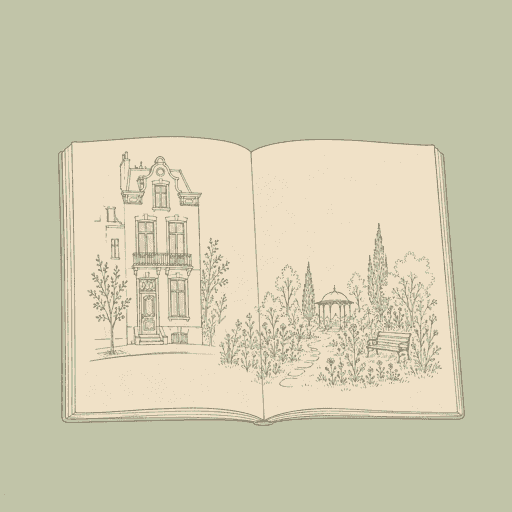
33 Place Brugmann
A modern alternative to SparkNotes and CliffsNotes, SuperSummary offers high-quality Study Guides with detailed chapter summaries and analysis of major themes, characters, and more.
Summaries & Analyses
Quizzes
NEWReading Tools
Character Analysis
Content Warning: This section of the guide includes discussion of ableism, religious discrimination, death, and animal death.
Charlotte Sauvin
Charlotte Sauvin is the novel’s protagonist, a round and dynamic character whose unique perception of the world shapes the narrative’s central concerns. As an artist who has colorblindness, Charlotte embodies the theme of The Limits of Objective Truth. Her experience of reality is different from those around her, yet she possesses a deep understanding of form, light, and composition. Her disability is thus framed as a distinct way of seeing, allowing her to create art celebrated for its stunning and unusual color combinations. Her father teaches her that her way of seeing is valid, telling stories that connect color to concepts she can grasp, such as when he explains that in a painting, two figures are wearing green, the color of leaves. Charlotte’s upbringing instills in her a quiet confidence in her own perception, making her a character who trusts what she feels and experiences over what others declare to be fact. Initially, Charlotte is emotionally reserved, having been “raised to be strong” (8), and she struggles to show vulnerability. Her relationships with her father, the Raphaël family, and Masha form an important support system that is dismantled by the war, forcing her to rely on her inner fortitude.
Charlotte’s development is driven by the progressive losses she endures and the moral compromises she must navigate as the Nazi occupation of Brussels upends her world. The departure of the Raphaëls, the absence of her husband Philippe, the death of her mentor Masha, and the eventual arrest of her father strip away her protected world, thrusting her into a reality of scarcity and danger. Her work, a central part of her identity, shifts from the high-minded pursuit of painting at the academy to the practical and clandestine creation of hats. This change reflects her adaptation to the occupation, where creating objects of beauty becomes both a means of survival and a subtle act of resistance. The hats she makes for the newsboy and even the antagonistic Miss Hobert are gestures of connection and transformation, injecting a small measure of dignity and humanity into a bleak environment. Her journey is one of hardening and awakening; while she maintains her composed exterior, the events of the war, her pregnancy, and her reconnection with Julian force her to confront the depths of her own emotions and her capacity for survival.
Ultimately, Charlotte becomes a quiet symbol of endurance. Her visions of the lioness, a mystical and protective feminine force, connect her to an alternate reality that exists beyond the grim facts of the occupation. This symbol reinforces the idea that there is more to the world than what can be rationally explained or observed. By the novel’s end, she is the sole occupant of her apartment, pregnant and alone. Nevertheless, having inherited her father’s belief in possibility and her own unique artistic vision, she finds the will to continue. Her decision to finally use the canvas left by the Raphaëls signifies her commitment to creation over destruction, embodying the theme of Art as a Repository of Humanity. She transforms from a protected girl into a self-reliant woman who, despite her deep losses, carries the memories of her loved ones and the potential for a new life, both in her art and in her unborn child.
Julian Raphaël
Julian Raphaël serves as the novel’s deuteragonist, a round and dynamic character whose intellectual journey transforms into one of moral action. Initially presented as a serious and brilliant mathematics student at Cambridge, Julian is deeply influenced by the philosopher Ludwig Wittgenstein. This intellectual framing establishes his preoccupation with logic, facts, and the nature of reality, connecting him to the theme of the limits of objective truth. His love for filmmaking with Charlotte provides an outlet for his artistic side, demonstrating his ability to see the world through a lens of both scientific precision and creative interpretation. His fascination with running films in reverse symbolizes a desire to control or reorder a world that is rapidly spiraling into chaos. Julian’s quiet, observant nature is a constant; he is described as the “most intelligent and serious person” Charlotte has ever met (4), a trait that remains even as he is forced into the brutal realities of war.
Julian’s defining relationship is his deep, unspoken love for Charlotte. He sees and understands her in a way no one else does, recognizing the validity of her perception and valuing her mind. By extension, his jealousy of Philippe stems from a feeling of being misunderstood by the one person he feels closest to. This emotional turmoil precipitates his transition from an academic to a man of action. His declaration to Charlotte that he will fight if war comes is a key moment, marking his commitment to opposing the Nazis. This decision is a logical extension of his moral code. Joining the RAF as a navigator is a perfect synthesis of his skills; he uses his mathematical mind to chart paths through the chaos of war, turning abstract knowledge into a tool for survival and resistance.
His experience as a fugitive after his plane is shot down marks his final transformation. Stripped of his uniform and instruments, he must rely on raw instinct, courage, and the kindness of strangers. His journey through Flanders and his escape from Brussels, aided by the very people he grew up with, forces him to confront the human element of survival that exists beyond calculated odds. His reunion with Charlotte is the emotional climax of his arc, a moment where he finally verbalizes his love, bridging the gap between his interior world and his actions. Even in this brief encounter, he is both a protector and the one in need of protection, showing the interdependence that has come to define relationships during the occupation. By the end, Julian has evolved from a boy who contemplates the world into a man who actively fights to save it, his intellectualism tempered by deep loss and a deepened capacity for love.
Francois Sauvin
Francois Sauvin, Charlotte’s father, functions as the novel’s moral compass and a mentor figure. A thoughtful and gentle architect, he is haunted by his experiences in the First World War, which caused him to experience a physical limp and gain a deep-seated understanding of human cruelty. This past trauma informs his fierce protectiveness of Charlotte and his commitment to creating spaces that foster humanity and connection. His architectural philosophy, which he describes as “an idea about how we should live” (35), is a direct counterpoint to the destructive ideology of the Nazis. For Francois, a building is a system of communication that can shape society for the better. This belief places him firmly within the theme of art as a repository of humanity.
Throughout the occupation, Francois maintains his dignity and principles, even as his world shrinks. He refuses to design buildings for the Nazis, leading to the closure of his firm. This act of quiet defiance is characteristic of his approach to resistance. He does not take up arms, but resists through acts of preservation and integrity. His most significant act is hiding the Raphaëls’ priceless art collection under the new parquet floor in their living room, a clever plan that transforms his home into a secret museum. This action symbolizes his dedication to safeguarding culture and memory against barbarism. He finds solace in small acts of creation, like brewing beer or sketching in his notebook, finding ways to cultivate life and beauty amidst overwhelming bleakness.
His final gift to Charlotte is his sketchbook, which contains his entire philosophy of hope. In its pages, he has redesigned 33 Place Brugmann into an idealized space where nature and structure are fused, and where all the residents, even the collaborators, are brought together in conversation. This book is his true legacy, proof of his unwavering belief that “[w]hat is thinkable is also possible” (342). His arrest is a tragic culmination of the petty betrayals of his neighbors, yet his final wave to Charlotte is one of encouragement. He is a round and largely static character, as his core values remain unchanged, but he is a powerful symbol of intellectual and moral resistance in the face of tyranny.
Leo Raphaël
Leo Raphaël is a pragmatic and resourceful art dealer who is a patriarch and protector for his family. As a round character, he is defined by his shrewdness and his deep love for both his family and his work. He views the world as a series of transactions and risks, a perspective encapsulated in his story of the “Bearskin” investors who “sold a bearskin before killing the bear” (29). This worldview allows him to recognize the Nazi threat earlier and more clearly than many of his contemporaries. While others hope for the best, Leo prepares for the worst, arranging his family’s escape to Great Britain and orchestrating a large-scale operation to save priceless artworks by hiding them in a Welsh quarry. His actions are driven by a calculated understanding of the dangers they face.
Leo is a foil to the more idealistic Francois. Where Francois resists by creating and preserving on a small, personal scale, Leo operates on a grander, more systemic one. He uses his international connections and financial acumen as weapons, demonstrating that pragmatism and morality are not mutually exclusive. His commitment to saving art is intertwined with his identity; he understands that the paintings are carriers of culture, history, and the very humanity the Nazis seek to destroy. His waking dream of the Parthenon being destroyed for its lead cores illustrates his deep anxiety about the destruction of civilization itself. Leo’s journey shows him grappling with the limits of his power; he can move paintings and people across borders, but he cannot protect his son, Julian, from the call to fight, a reality that causes him immense pain.
Masha Balyayeva
Masha Balyayeva is a mentor to Charlotte and a narrator whose cynical perspective provides a contrast to the idealism of other characters. A refugee from Russia with a Nansen passport, she arrives in Brussels with nothing and builds a successful life as a seamstress through her talent and confidence. Her worldview is shaped by early trauma and a belief that “[a]ll men are dogs” (16), a philosophy that arms her against a predatory world. Yet, beneath this hardened exterior, she possesses a deep capacity for love, which is most evident in her maternal affection for Charlotte and her passionate, all-consuming relationship with the spy, Harry. Masha’s atelier in the attic of Number 33 is a place of magic and sanctuary, particularly for Charlotte, to whom she imparts wisdom about life, art, and survival.
As a round and dynamic character, Masha’s life takes a dramatic turn when she becomes involved with Harry and the resistance. Her skills as a seamstress, which require an understanding of illusion and transformation, translate seamlessly into the world of espionage. She becomes an active participant in the fight against the Nazis, undertaking dangerous missions that ultimately lead to her death. Her murder is shrouded in ambiguity, a reflection of the theme of the limits of objective truth; Harry claims he killed her as an act of mercy to prevent her capture, but Masha’s own narration leaves the final moments uncertain. Her story is a tragic testament to the brutal realities of resistance work, where trust is a liability and betrayal can come from the most intimate sources. Even after her death, she remains a guiding presence for Charlotte, a symbol of resilience and tragic love.
Dirk DeBaerre
Dirk DeBaerre is one of the novel’s most complex and morally ambiguous characters, a round and dynamic figure who evolves from a petty childhood antagonist to a key player in the story’s climax. Initially, he is presented as a resentful and cruel boy who torments Charlotte about her colorblindness. As a young man, he remains an unsettling presence in the building, an observer who attends collaborationist meetings, with whom he initially aligns himself. His motivations appear to be rooted in self-preservation and a deep-seated resentment stemming from the discovery of his true parentage. He embodies a quiet, watchful form of complicity, gathering information and positioning himself to survive no matter which side wins. His saxophone playing, which torments his neighbors, serves as an outward expression of his discordant inner life.
However, Dirk’s character pivots in an important and unexpected way, challenging any simple reading of him as a villain. His decision to help Julian escape and to warn Charlotte about the Gestapo’s trap is a deep act of redemption. This turn is rooted in a long-held debt he feels toward Charlotte. His offering of the red pencil stub from their childhood is a powerful symbolic gesture, an admission of his past cruelty and a repayment for a wrong he has carried for years. In this moment, Dirk uses the information he has gathered to save a life, demonstrating a hidden moral compass. His final actions prove that even characters who appear deeply enmeshed in The Cost of Passive Complicity are capable of decisive, heroic acts, making him a fascinating study of shifting morality under pressure.
Agathe Hobert
Miss Agathe Hobert is a key secondary character who vividly represents the cost of passive complicity. A lonely and resentful former café proprietor, she lives a life of quiet bitterness, defined by what she has lost and what she feels she is owed. Her primary action in the novel is listening and reporting. Trapped in her apartment, she turns her acute hearing into a weapon, monitoring the comings and goings of her neighbors. Her suspicion and her need to assert her own minor authority lead her to report “voices” in the Colonel’s apartment to the notary. This act, seemingly small and driven by a desire for order and a misguided sense of civic duty, has catastrophic consequences, directly leading to Gestapo searches and placing her neighbors in mortal danger. Rather than embody an ideological Nazi, she represents a bystander whose personal grievances make her an unwitting tool of the oppressive regime.
Despite her role as an antagonistic force, Miss Hobert is portrayed as a round, if static, character. The novel reveals the roots of her bitterness in her family history and her unmarried status, presenting her as a deeply unhappy woman. Her world is small, and her power is limited to what she can glean through the thin walls of the building. The one moment of grace in her arc comes when Charlotte makes her a hat. For a brief instant, the hat transforms her, allowing her to see a more beautiful version of herself. This act reveals a buried desire for beauty and connection, adding a layer of tragic complexity to her character. However, this moment does not fundamentally change her; she remains suspicious and self-interested to the end, illustrating how personal unhappiness can curdle into dangerous complicity.
Colonel Herman Warlemont
Colonel Herman Warlemont is a symbol of quiet, unassuming heroism. Initially appearing as a gruff, retired military man grieving the loss of his wife, he gradually reveals himself to be an important member of the resistance. His apartment, 3L, becomes a safe house on the escape line for downed Allied airmen. The Colonel’s cover story, that he is caring for men with disabilities displaced by a fire, is a clever guise that allows him to move fugitives through the building under the noses of collaborators like Miss Hobert and the notary. He is a static character, as his moral principles are unwavering, but he is also round, displaying a dry wit and a deep well of compassion beneath his military exterior. The training of his dog, Zipper, to attack on command is a brilliant and pragmatic piece of planning that proves essential in a moment of crisis. The Colonel represents the ordinary citizens who, without fanfare, chose to do extraordinary and dangerous things for the sake of their principles.
Jan Everard
Jan Everard, the notary on the ground floor, is a flat character who is a clear example of a collaborator. Motivated by a combination of professional resentment, Flemish nationalism, and financial greed, he aligns himself with the new regime. He manages the building as an agent of the occupation forces, monitoring his tenants and reporting information for personal gain. He receives a “Christmas bonus” for informing the authorities about the potential value of the art left in the Raphaëls’ apartment, a direct transaction that trades his neighbors’ security for his own profit. His willingness to participate in the search of the Colonel’s apartment and his deference to the Nazi official Van Cauter solidify his role as a man who has chosen the path of collaboration to advance his own standing.
Philippe Kahn
Philippe Kahn is an architect, artist, and Charlotte’s husband. He functions primarily as a catalyst for Charlotte’s emotional awakening and as a foil to Julian. He is passionate, intense, and deeply committed to fighting the Nazis, having already been involved with the resistance before the occupation of Belgium. His decision to leave Charlotte to join the fight in France emphasizes his dedication to the cause, which he prioritizes above his personal safety and even their new marriage. He shares an intellectual connection with Francois and Julian through their mutual admiration for Wittgenstein, but his approach to life is more visceral and immediate. Though his time in the narrative is brief, his presence looms large for Charlotte, representing a life of passion and possibility that is tragically cut short when he is killed in action.

Unlock analysis of every major character
Get a detailed breakdown of each character’s role, motivations, and development.
- Explore in-depth profiles for every important character
- Trace character arcs, turning points, and relationships
- Connect characters to key themes and plot points
Featured Collections
Art
View Collection
Books that Feature the Theme of...
View Collection
Community
View Collection
Earth Day
View Collection
Equality
View Collection
Family
View Collection
Forgiveness
View Collection
Friendship
View Collection
Good & Evil
View Collection
Loyalty & Betrayal
View Collection
Memorial Day Reads
View Collection
Military Reads
View Collection
Mortality & Death
View Collection
Safety & Danger
View Collection
The Past
View Collection
Trust & Doubt
View Collection
Valentine's Day Reads: The Theme of Love
View Collection
War
View Collection
World War II
View Collection