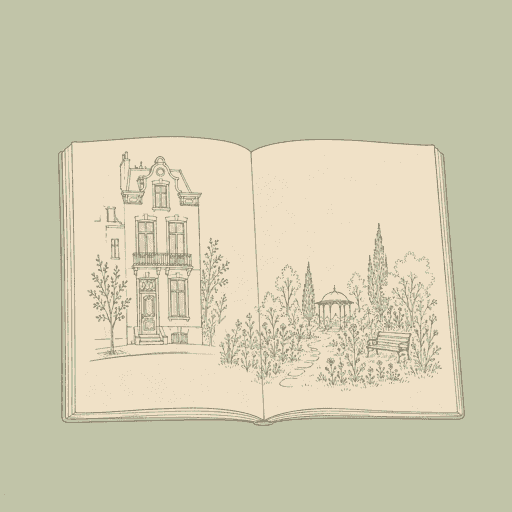
33 Place Brugmann
A modern alternative to SparkNotes and CliffsNotes, SuperSummary offers high-quality Study Guides with detailed chapter summaries and analysis of major themes, characters, and more.
Summaries & Analyses
Quizzes
NEWReading Tools
Prologue-Part 1Chapter Summaries & Analyses
Content Warning: This section of the guide includes discussion of animal death, graphic violence, death, religious discrimination, ableism, bullying, and mental illness.
Part 1: “Before”
Prologue Summary
The Raphaël family flees their Brussels apartment in the middle of the night, leaving nearly all their possessions behind. Amid rumors that they took their silver and that their valuable paintings have vanished, their neighbor, Charlotte Sauvin, finds a box containing films, a projector, a set of oil paints, and a blank canvas. There is a note that reads, “For Charlotte” on the canvas. The personal nature of the note makes the family’s departure feel real and final to her.
Part 1, Chapter 1 Summary: “Charlotte Sauvin, 4L”
The novel flashes back to August 1939. In their Brussels apartment building, 17-year-old Charlotte Sauvin is woken by her neighbors, siblings Julian and Esther Raphaël. The three, along with Charlotte’s father, Francois, have become close. They have spent the summer making films with a prototype movie camera that Julian’s father, Leo, brought from the United States. Moviemaking has been a welcome distraction for Charlotte from her relationship with Philippe Kahn, an older architecture student she met in Antwerp, who was distant when he left for Spain in June.
While loading film outdoors in the square, Julian tells Charlotte about witnessing Ludwig Wittgenstein and Alan Turing argue about the liar’s paradox at Cambridge. The liar’s paradox suggests that a liar who says that he is lying is contradicting himself because he is telling the truth about his lie. Julian and Charlotte debate it, with Charlotte calling the paradox silly because actions matter more than what people claim. Julian indicates that this is Wittgenstein’s position as well. They start filming when a cat is struck and killed by a car; Julian continues to film as the cat dies, and Charlotte is overcome by a vision of the square filling with blood. Later, as they develop the film, Julian declares that if war breaks out, he will fight. He asks Charlotte to think of him as though she were praying, but she dismisses the idea of war. Charlotte thinks of seeking comfort from Masha Balyayeva, a seamstress who lives upstairs in their apartment, but recalls she has gone away.
A flashback reveals that during the spring, Charlotte pricked her finger while telling Masha about Philippe, and a drop of blood on a piece of fabric prompted Masha to give it to her, calling the blood a sign of her ownership.
Part 1, Chapter 2 Summary: “Masha Balyayeva, 5th Floor”
Masha Balyayeva, a seamstress, recounts her arrival in Brussels in 1924 as a refugee from post-revolutionary Russia. Her mother was killed in a pogrom, and her rabbi uncle gave her three contacts in Brussels before she fled. The third, Sophia Raphaël, tested her sewing skills, gave her the name “Masha,” and allowed her to live and work in the building’s small fifth-floor maid’s room.
Over the years, Masha built a successful business and became a mother figure to Charlotte, who often visited her atelier and displayed a natural artistic talent. Masha maintains a friendship with Colonel Warlemont, a widower who lives on the third floor, though she stresses they never had a romantic or sexual relationship. It was the Colonel who introduced her to a man named Harry, her romantic interest.
Part 1, Chapter 3 Summary: “Leo Raphaël, 4R”
Leo Raphaël, an art dealer and the father of Julian and Esther, reveals that his recent trip to the United States was a business journey. He had been planning to move the family to the United States, but was blocked when the US met its immigration quotas. While in London, he met with a cousin connected to the art world and, reminding him how many paintings were lost to German looters between 1914 and 1918, proposed a plan to safeguard valuable paintings from potential Nazi looting.
Back in Brussels, Leo receives his cousin’s counter-proposal. He then has lunch with a buyer named Mats, who offers to act as a “front” for Leo’s business when antisemitic laws eventually prevent him from working. During the meal, Leo experiences a disorienting vision of the other patrons as animals and is overcome with a sense of dread. He flatly rejects Mats’s proposal, telling him he has no taste and cannot be trusted. The disturbing lunch solidifies Leo’s resolve, and he decides to accept his cousin’s plan.
Part 1, Chapter 4 Summary: “Francois Sauvin, 4L”
Francois Sauvin, an architect and Charlotte’s father, reflects on a recent visit from Leo Raphaël, who made him an unspecified business proposal. Francois believes a time is coming when everyone will have to make a moral choice, and he tells Leo he will never design buildings for the Nazis. After Leo leaves, Francois decides to replace the living room’s pine floor with a more elegant parquet.
He remembers discovering Charlotte’s colorblindness when she was three, along with the day his wife died in childbirth. He was overwhelmed with grief until Sophia Raphaël stepped in to help him care for his infant daughter. He confesses he initially resented Charlotte, the baby who came when his wife left, before she transformed his outlook and gave him a reason to live.
Part 1, Chapter 5 Summary: “Agathe Hobert, 3R”
Agathe Hobert, a lonely and suspicious woman living on the third floor, bakes for the widowed Colonel but resents that he never invites her inside his apartment. She spies on his visitors, including Masha and a man named Harry. One day, she sees Julian and Esther with a butter cake she baked for the Colonel and is annoyed he gave it away.
Determined to cause trouble, Miss Hobert goes to the Raphaëls’ apartment. She announces that her cake contains both butter and lard, expecting the Jewish family to be horrified by the mixing of dairy and meat fat. However, Leo and Sophia are completely unfazed, and Leo remarks that it is a sign that people wrongly assume they keep kosher. The arrival of Francois, who is joining the Raphaëls for dinner, saves Miss Hobert from the awkward encounter.
Part 1, Chapter 6 Summary: “Francois Sauvin, 4L”
Francois is visited by his neighbor Martin DeBaerre, who makes a mysterious request that moves Francois to tears. Later, Francois reflects on Charlotte’s childhood. He recalls the pain of the gas attacks he witnessed during the Great War, which made him feel betrayed by color and motivated him to teach his daughter to understand the world through form and light in the absence of color.
He remembers when Martin’s son, Dirk, revealed Charlotte’s condition to their classmates, leading to cruel teasing. To comfort her, Francois told her a story about a harbor that once existed at Place Sainte-Catherine in Brussels, connecting it to a Boudin painting in the Raphaëls’ hallway. This helped her conceptualize the color green. He fostered her talent for drawing, which was also encouraged by Masha. He remains awake, troubled by his thoughts about Martin’s request.
Part 1, Chapter 7 Summary: “Charlotte Sauvin, 4L”
Julian avoids Charlotte, angry that she has a boyfriend. Charlotte is sketching Esther when she learns of the German-Soviet non-aggression pact. One morning, Charlotte discovers the Raphaëls have fled during the night. She feels betrayed by their silence, though her father insists they left without a word to protect their friends from being implicated.
That fall in Antwerp, France declares war on Germany. At a party hosted by Charlotte’s teacher, Professor Weiss, a French and a German student get into a violent fight. Philippe forcefully breaks it up. Afterward, he and Charlotte return to her flat and sleep together. Soon after, they tell Francois they plan to marry; under pressure from the escalating political crisis, he gives his blessing.
As winter arrives, Charlotte helps Professor Weiss pack his art collection into crates before he goes into hiding to escape persecution for being Jewish and gay. Charlotte and Philippe marry in secret, with only her father and a priest as witnesses; they sign a ketubah, and the priest reads the seven blessings, having been helped in this by a rabbi he has been hiding. She observes that her father and Philippe share an obsession with Wittgenstein’s Tractatus Logico-Philosophicus, and recalls that Julian also loves the book, though she has no desire to read it herself.
Part 1, Chapter 8 Summary: “Sophia Raphaël, 4R”
Now in a remote family home in the Outer Hebrides of Scotland, Sophia Raphaël experiences anxiety. The sea journey was terrifying, and the cold stone house offers little comfort, especially since she spends most of her time alone. Leo is in London on business, Esther volunteers at a local hospital, and Julian is at Cambridge.
Sophia reflects on their escape, recalling how they practiced sneaking down the stairs in stockinged feet to avoid alerting neighbors like the prying Miss Hobert, who had already noticed the family taking the stairs instead of the elevator. Sophia notes she should have been taking the stairs all along to avoid arousing suspicion. Alone and unnerved, she worries that Esther’s appearance makes her a target and regrets they could not bring Charlotte with them. She looks at her aging reflection and feels a sense of despair. Knowing Julian will likely enlist in the army as soon as he is able, she resolves to write letters to Charlotte and Masha.
Part 1, Chapter 9 Summary: “Masha Balyayeva, 5th Floor”
Masha reflects on her intense and dangerous relationship with Harry. After they became lovers, she began working for his resistance network, delivering messages. They spent most of their time in Paris, where Harry correctly predicted the French army would quickly collapse against a Nazi invasion. Sophia Raphaël sent Masha a letter urging her to flee to Scotland alone, but by then it was too late.
Masha recounts a mission near German-occupied territory. Their driver, a young man from Strasbourg, told a gruesome story about how foie gras is made by blinding and force-feeding geese. Harry sensed they were being led into a trap. When the driver refused to turn the car around, Harry shot him in the shoulder, then ordered him out of the car. Before shooting him dead, Harry taunted him, explaining afterward to Masha that the driver was a traitor and they were his intended “geese.”
Prologue-Part 1 Analysis
The novel’s opening chapters establish its narrative shape through a rotating series of first-person accounts, with sections titled by character name and apartment number. This polyvocal structure immediately fragments the narrative, presenting events through the distinct, subjective lenses of Charlotte, Masha, Leo, Francois, Agathe, and Sophia. Each voice offers a partial and often biased perspective, forcing the reader to synthesize a more complex understanding of the narrative from competing testimonies. Agathe Hobert’s paranoid surveillance of her neighbors, for instance, casts their actions in a sinister light, while Francois Sauvin’s tender recollections of Charlotte’s childhood and Sophia Raphaël’s anxious maternal reflections provide contrasting emotional textures. This technique highlights The Limits of Objective Truth by demonstrating that no single character possesses an authoritative view. Though Charlotte is presented as a protagonist, the truth of life at 33 Place Brugmann is not exclusive to her. Rather, it emerges from the complex, overlapping, and sometimes contradictory mosaic of individual experiences.
Charlotte’s description of the apartment building, where “every sound travels” through its interconnected structure (3), introduces the symbol of the building at 33 Place Brugmann as a microcosm of pre-war European society. The physical layout creates a forced intimacy where residents are constantly aware of one another, making secrets nearly impossible to keep. Sounds from Dirk’s saxophone, Miss Hobert shouting, and the flush of toilets create an acoustic map of the community, binding the residents together while also creating the suspicion that fuels Miss Hobert’s spying. Charlotte perceives the building as a “fortress,” yet its internal permeability suggests a vulnerability that mirrors the fragile state of a society on the verge of collapse. This setting becomes an important stage for the moral dramas that unfold, examining how a community built on proximity responds when faced with an existential external threat.
The residents’ engagement with art and philosophy provides a framework for their attempts to process a world descending into chaos. Julian’s account of the Cambridge debate between Wittgenstein and Turing over the liar’s paradox introduces the symbol of Wittgenstein’s Tractatus Logico-Philosophicus, foreshadowing the search for meaning in a world where logic has begun to collapse. It also establishes Charlotte’s resistance to the lofty ideas of philosophy, characterizing her as a young woman grounded in the immediate reality of the world that surrounds her. Her pragmatic worldview contrasts with the intellectual systems that fascinate Julian, Francois, and Philippe, who use the Tractatus to search for the intellectual order that can explain something as illogical as burgeoning Nazi Europe. This dynamic establishes a central tension between abstract truth and lived experience, which the narrative accounts for by introducing the motif of art. For the residents, creating and preserving art, whether through Charlotte’s sketches, the group’s films, or Leo’s work safeguarding paintings, becomes an essential alternative to logic. This focus on creative acts emphasizes the theme of Art as a Repository of Humanity, positing that in times of crisis, art can preserve truths that philosophy alone cannot capture.
Early moral choices made by the characters reveal the escalating stakes of the political situation and anticipate The Cost of Passive Complicity. When the art buyer Mats proposes to act as a “front” for Leo’s business, he represents an opportunistic collaboration with the encroaching Nazi regime. Leo’s visceral vision of Mats as a pig strips away the veneer of a normal business transaction, exposing its predatory nature and prompting Leo to refuse any part in it. Similarly, Francois’s declaration that he “won’t design buildings for the Nazis” is an early, definitive stand against complicity (35). Masha’s work with Harry’s resistance network marks an even more active commitment. These decisions stand in sharp contrast to the passive self-interest and petty grievances of characters like Miss Hobert. The driver’s gruesome story about force-feeding geese to produce foie gras is a chilling allegory for the calculated cruelty of the Nazi project, a system Harry recognizes as a trap for him and Masha, whom he calls “his geese.”
The narrative repeatedly uses blood to signify the unavoidable reality of the violence that looms over the characters’ lives. After witnessing a cat’s death, Charlotte is overwhelmed by a vision of the square flooding with blood that “is seeping out under [the church] doors” (11), a premonition of the bloodshed that will soon engulf Europe. The image of indifferent passersby wading through the gore suggests a widespread denial of the coming war. The image of blood recurs when Masha pricks her finger, and the drop of blood on a piece of fabric becomes a “sign” of fate, and again when Harry uses his handkerchief to stanch the blood from a scratch on Masha’s leg. These instances link blood to destiny, violence, and the physical body, grounding the novel’s intellectual and emotional conflicts in a reality that cannot be escaped through art, philosophy, or the perceived safety of home.

Get in-depth, chapter-by-chapter summaries and analysis from our literary experts.
- Grasp challenging concepts with clear, comprehensive explanations
- Revisit key plot points and ideas without rereading the book
- Share impressive insights in classes and book clubs