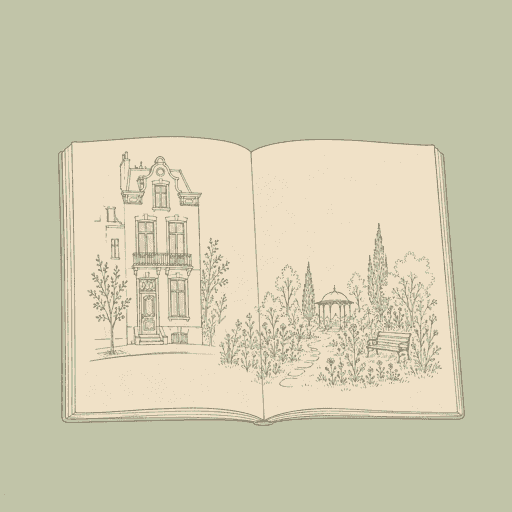
33 Place Brugmann
A modern alternative to SparkNotes and CliffsNotes, SuperSummary offers high-quality Study Guides with detailed chapter summaries and analysis of major themes, characters, and more.
Summaries & Analyses
Quizzes
NEWReading Tools
Part 2, Chapters 19-27Chapter Summaries & Analyses
Content Warning: This section of the guide includes discussion of death, graphic violence, illness, and religious discrimination.
Part 2: “After”
Part 2, Chapter 19 Summary: “Julian Raphaël, 4R”
While on a two-day leave from the Royal Air Force, Julian meets his father, Leo, at a bar. Leo explains that he is working with London’s National Gallery to display one painting a week to boost public morale, an idea that came from a letter in the Times. He organized one delivery using a Cadbury truck, and reads aloud the announcement that Turner’s Frosty Morning will be on display for a month, a painting selected through a public poll. Leo believes the project reminds people of their identity and culture during the war.
The conversation stirs a memory of Leo taking Julian to an art auction in Italy years ago. Leo recalls Julian’s surprising focus and business acumen, noting how the boy, who normally couldn’t sit still, astutely advised him on bidding. They both acknowledge that one painting of a river scene that Julian loves in their family’s collection is exceptionally valuable. Leo invites Julian to join the art business after the war. The weight of the past and the present causes Leo to cry, an emotional display Julian has never witnessed from his father before. Unsettled, Julian runs from the pub, and Leo chases after him, smiling through his tears. This meeting occurs just before a dangerous bombing mission over Belgium.
Part 2, Chapter 20 Summary: “Colonel Warlemont, 3L”
Colonel Warlemont receives a letter from Masha that has been secretly opened and resealed. In it, she claims to be safe at a farm. Shortly after, the Colonel sees Charlotte and observes that she has grown more mature. She recounts an encounter from almost two years ago where a Nazi officer gave her a butter ration after the grocer, Smets, had refused her.
Sometime later, a distraught Harry arrives. He confesses that Masha died in Paris. Masha was part of a resistance line helping an escaped RAF pilot. Amidst fears of an informant within their group, Masha went to a café to meet a contact but sensed a trap. The contact was not who he claimed to be. She was shot while fleeing to a secondary meeting point. Harry, arriving moments late, found her dying as the Gestapo closed in. He says she was dead when they reached her. Devastated, the Colonel listens as Harry asks for a favor: He needs help protecting other RAF pilots coming through Brussels, as their escape line has been compromised. The Colonel agrees.
Part 2, Chapter 21 Summary: “Esther Raphaël, 4R”
Writing as a nurse in a series of clinical notes from November 1942, Esther Raphaël documents the horrific injuries of soldiers she treats, including severe burns, shrapnel wounds, and amputations. One young patient proposes to her, arguing in probabilistic terms that marrying him would give his life meaning regardless of outcome. When she refuses, he returns two weeks later with catastrophic new injuries and jokes about her missed opportunity. She kisses him as morphine puts him to sleep.
While treating an RAF pilot for severe burns, Esther asks if he knows her brother, Julian. The boy thinks he may have heard of him. He ultimately loses a foot. Another patient, who crashed in Belgium and was aided by the local resistance, does not know Julian. Her work culminates in a gruesome case where a 24-year-old soldier dies after his legs are amputated. Unable to ask him about her brother in time, Esther retrieves his amputated limbs from the incinerator room to be buried with his body. The relentless trauma leads Esther to decide she no longer believes in God and will never marry. Fearing the news would devastate her parents, she resolves to keep her resolutions secret, making Julian’s survival all the more critical.
Part 2, Chapter 22 Summary: “Charlotte Sauvin, 4L”
Charlotte dreams that Esther’s hair is being shorn like a sheep’s, and they are both crying, breaking their promise not to weep until the war is over. She receives a letter from Mrs. Raphaël mentioning that Julian is in the RAF. Charlotte stores the letter with the movie camera and films under her bed. Soon after, the Colonel visits and informs Charlotte and Francois that Masha is dead. The shock causes Charlotte to experience a severe migraine with visual distortions.
Later that night, unable to sleep, Charlotte looks out her window and sees a mystical lioness in the square below. The creature is still there in the morning, and she watches a car pass directly through it unharmed. The vision remains her secret. Thinking of Philippe and their one meeting in Antwerp, she wraps a pair of his trousers around her pillow for comfort. She resolves to soon tell her father that she is pregnant.
Part 2, Chapter 23 Summary: “Masha Balyayeva, 5th Floor”
Narrating from beyond the grave, Masha recounts the day of her death in Paris. She was on a mission to escort a young RAF pilot, posing as his lover while meeting a “shuttle,” or contact. She wore a conspicuous camel-hair coat she had made herself, with a tailoring suggestion from Charlotte. Masha immediately suspected the shuttle was an impostor; his accent was wrong, he fumbled with local currency, and she saw he was hiding a missing fingertip. She realized he was a Flemish collaborator, rather than a Canadian ally.
When she knew her cover was blown, she left the café, hoping the pilot had already escaped through a basement exit as planned. Masha was shot in the neck as she fled. Bleeding heavily, she stumbled to the emergency rendezvous point, where Harry arrived late. As Harry held a dying Masha and other footsteps approached, she felt the cold barrel of a gun against her head. From the afterlife, she reflects on her murder, uncertain of who pulled the trigger or why: whether it was to spare her from torture, to protect the resistance, or for some other reason. She also reveals that she and Harry never married because he wanted children and she did not, citing the impossibility of raising a child amid war and starvation.
Part 2, Chapter 24 Summary: “Agathe Hobert, 3R”
Miss Hobert watches Charlotte give a handmade wool hat to the local newsboy and feels slighted. Later, in the building’s lobby, she sees the notary, Everard, with an unknown Flemish man. She complains to her neighbor Dirk DeBaerre about Charlotte not making her a hat. Hobert is also agitated by the Colonel, who has taken in several men who are deaf into his apartment. She suspects he is receiving money for housing them.
The Colonel later asks to borrow some of Hobert’s puzzles for the men. Annoyed, she gives him two puzzles that are each missing a piece. Feeling a mix of guilt and spite, she goes to Charlotte’s apartment the next day and commissions a small, stylish cap from her. Charlotte measures her head and recommends a “winter sky” blue cashmere fabric. Hobert agrees but insists she will only pay the full amount after a final fitting, demonstrating her distrust.
Part 2, Chapter 25 Summary: “Francois Sauvin, 4L”
After Miss Hobert commissions a hat from Charlotte, she warns Francois to be wary of the Colonel and his new tenants. Francois dismisses her. Later, the Colonel visits for a beer and explains that he is housing the men because his late wife was devoted to their cause; their previous home had burned down. He also notes with pride that the men are making new pieces for the incomplete puzzles Hobert gave him.
While they talk, Francois puts on music, and he and Charlotte share a spontaneous dance. The Colonel then mentions that RAF bombing missions are getting closer to Brussels, a remark that unnerves Francois, who suspects his son-in-law Philippe is involved in something related to the anti-German resistance. After the Colonel leaves, Francois recalls telling a young Charlotte a story inspired by the Raphaëls’ Monet painting. He then retreats to his sketchbook, where he defies the occupation by designing fantastical, nonlinear buildings he knows will never be built.
Part 2, Chapter 26 Summary: “Charlotte Sauvin, 4L”
Charlotte struggles to read Wittgenstein’s Tractatus, finding its fragmented style difficult. She grows increasingly worried about her father’s detached calm and his total absorption in his architectural drawings.
After finishing Miss Hobert’s hat, she delivers it to her. The hat is a triumph, transforming Hobert’s appearance. Though visibly pleased, Hobert remains dismissive. As she pays Charlotte in the hallway, Dirk DeBaerre appears. Impressed, Dirk immediately commissions a hat for himself.
Charlotte reluctantly agrees and has Dirk follow her upstairs for a fitting. She finds the process of measuring his head strangely intimate. While preparing the wool for his hat, she imagines it on Philippe or Julian instead. The thought leads her to remember a day from her childhood when she confessed that she had colorblindness to Julian, and he accepted it without question. She realizes that with Julian, she feels both perfectly alone and perfectly complete.
Part 2, Chapter 27 Summary: “Dirk Debaerre, 2R”
Dirk, an observer by nature, clears out his deceased mother’s hoarded possessions. To maintain his cover as a collaborator and gather intelligence, he attends meetings of the VNV, the Flemish nationalist group. His long-standing presence there has made him appear trustworthy, deflecting any suspicion about his parents’ deaths. He learns from Miss Hobert that her tenant near the Gare du Midi is a man named Putzeis, whom Dirk recognizes from the VNV meetings. Suspicious of Putzeis’s unexplained wealth, Dirk begins to follow him.
After seeing Putzeis picked up by a mysterious car, Dirk borrows Hobert’s vehicle to continue his surveillance. He follows Putzeis and observes him deliver three men to a train station where Gestapo agents are waiting. Dirk infers that Putzeis is informing on what appear to be Allied airmen being moved through an escape network. Dirk leaves before the arrests. Later, Hobert tells him a new tenant has moved in and that the notary, Everard, received a bonus for telling authorities the Raphaëls’ valuable art may be hidden in their former apartment. Dirk also confirms his suspicion that the notary’s wife, Annick, is reading the residents’ mail.
Part 2, Chapters 19-27 Analysis
Leo’s mission to display a single painting weekly at London’s National Gallery is a public act of cultural defiance. Leo frames the project as a way to remind the English people “[o]f who we are. As people” amid the destruction of war (191), transforming paintings from commodities into essential repositories of identity. The project is communal in nature, with the public voting on which artwork to see. This public preservation of culture contrasts sharply with Francois’s private defiance in his sketchbook, where he designs fantastical, nonlinear buildings that will never be constructed. Both men use their artistic sensibilities to create and protect worlds insulated from the rigid, destructive logic of the occupation, illustrating the theme of Art as a Repository of Humanity. The discussion between Leo and Julian about the family’s most valuable painting further complicates this theme, showing the dual nature of art as both a priceless cultural emblem and a tangible financial asset. This tension becomes acute when the notary, Everard, later reports the Raphaëls’ collection to the authorities for a personal bonus, turning a cultural treasure into an object of opportunistic betrayal.
Dirk DeBaerre’s covert surveillance of the collaborator Putzeis reveals the mechanics of betrayal that operate beneath the surface of occupied Brussels. By following Putzeis and witnessing him deliver Allied airmen to the Gestapo at the train station, Dirk observes the most malevolent form of complicity. This ideologically driven treachery is the height of collaboration that extends into the residents’ daily lives. The notary’s decision to leverage information about the Raphaëls’ hidden art for a Christmas bonus is a less violent but still damaging act of self-interest, translating cultural heritage into personal gain. His wife, Annick, steams open and reads her neighbors’ mail, a small but significant violation that destroys the community’s trust from within. Even Miss Hobert’s petty grievances, including giving the Colonel puzzles with missing pieces and complaining about his tenants, contribute to the atmosphere of suspicion. These actions demonstrate how The Cost of Passive Complicity is built upon an accumulation of smaller, self-serving choices that corrode social bonds and enable the regime’s power. As a passive observer to the conflict, Dirk’s vantage of Putzeis drives him to resolve his position in the war. Either he becomes like the treacherous Putzeis and sells his soul to the occupying forces, or he acts as many of his neighbors do, albeit at great personal cost.
Charlotte’s mystical vision of a lioness in the square introduces a mode of understanding that exists outside the rational frameworks other characters use to navigate the war. The creature, through which a car passes harmlessly, shows a reality that is subjective and impervious to the physical laws of a violent world. This embrace of the inexplicable is echoed in her engagement with Wittgenstein’s Tractatus, as she challenges its logical propositions against her own lived experience, particularly the statement that “objects are colorless” (242). Her color-blindness makes this an intensely personal philosophical problem, rather than an abstract one. This questioning illustrates the theme of The Limits of Objective Truth, suggesting that empirical facts and logical systems are insufficient for comprehending trauma and occupation. Other characters also turn to non-rational acts to cope. Esther’s decision to retrieve a dead soldier’s amputated legs for burial is a ritualistic gesture of humanity that defies clinical procedure. Similarly, Francois’s retreat into designing impossible, fantastical buildings is a rejection of the brutalist logic imposed on his city and his profession.
The motif of hats develops in these chapters as an object of both connection and concealment, while clothing more broadly becomes a signifier of identity and fate. Charlotte’s craft first appears as an act of generosity when she gives a warm wool hat to the newsboy, a simple gift that elicits a rare smile. This contrasts with the hat she makes for Miss Hobert, which is a commercial transaction born of vanity and envy. The “winter sky” cashmere hat is a triumph that transforms Hobert’s appearance, demonstrating the power of apparel to construct an identity. The motif takes on a more functional role when Dirk commissions a hat, which he subsequently wears for practical warmth and concealment while conducting his dangerous surveillance of Putzeis. The significance of clothing as an identity marker culminates in Masha’s posthumous narrative, where she reflects on her beautiful, conspicuous camel hair coat. While a source of personal pride and a connection to Charlotte’s tailoring advice, its distinctiveness makes her an easy target, turning an object of elegance into what she calls her “beautiful shroud.”
Esther and Masha experience the casualties of the war firsthand, allowing the novel to explore alternate forms for storytelling that move beyond the grounded realistic narration that much of the novel has deployed thus far. Esther’s notes attempt to impose a clinical, objective order on the chaos of the hospital ward by reducing soldiers to their injuries and treatments. This detached approach fails when she confronts the human reality of a young patient’s desperate proposal, based on the cold probability that “[l]ive or die is fifty/fifty” (203). Her emotional response to kiss the grievously wounded boy and later retrieve another’s amputated limbs reveals the inadequacy of objective language to contain suffering. This failure is mirrored in Masha’s narration. From beyond the grave, she can lay out the sequence of events leading to her death but cannot provide the ultimate truth of who killed her or why. The narrative’s rapid shifts between these deeply personal, incomplete accounts construct a mosaic of trauma, suggesting that the “truth” of the war can only be built through a collection of shattered perspectives.

Get in-depth, chapter-by-chapter summaries and analysis from our literary experts.
- Grasp challenging concepts with clear, comprehensive explanations
- Revisit key plot points and ideas without rereading the book
- Share impressive insights in classes and book clubs