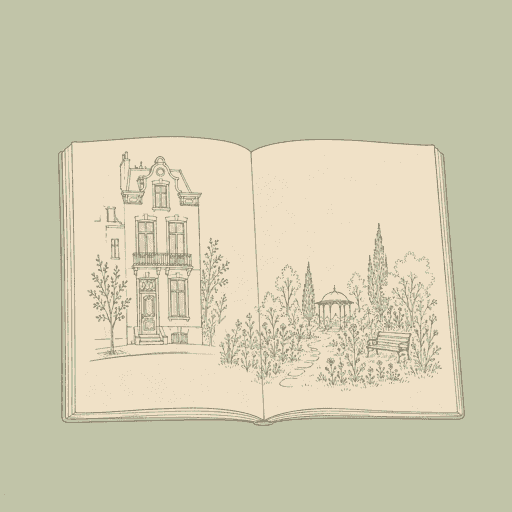
33 Place Brugmann
A modern alternative to SparkNotes and CliffsNotes, SuperSummary offers high-quality Study Guides with detailed chapter summaries and analysis of major themes, characters, and more.
Summaries & Analyses
Quizzes
NEWReading Tools
Book Club Questions
Content Warning: This section of the guide includes discussion of antisemitism and death.
General Impressions
Gather initial thoughts and broad opinions about the book.
1. The novel is told from the perspectives of many different residents of 33 Place Brugmann. How did this chorus of voices affect your connection to the story and its characters? Did you have a favorite narrator whose perspective you looked forward to most?
2. How did you feel about the book’s blend of real historical events, like the attack on the Gestapo headquarters, with the fictional lives of its characters? Many novels explore civilian life during World War II, such as Anthony Doerr’s All the Light We Cannot See or Nicole Krauss’s The History of Love. How does 33 Place Brugmann’s focus on a single apartment building compare to other stories of the occupation you may have read?
3. What was the most memorable or surprising element of the book for you? Was it a particular character’s decision, a plot twist, or a specific image that has stayed with you since you finished reading?
Personal Reflection and Connection
Encourage readers to connect the book’s themes and characters with their personal experiences.
1. Francois’s final words in the novel urge Charlotte to draw hope from her imagination. How do you feel about this insight? Do you personally find it helpful or difficult to find hope in things?
2. Charlotte’s colorblindness does not hinder her from seeing the world. It even becomes the source of her artistic strength. Think about a time when a personal trait that some might see as a limitation actually gave you a unique perspective or strength. How does Charlotte’s journey encourage us to value different ways of seeing?
3. The relationships between the residents of Number 33 are complex, ranging from deep friendship to suspicion and betrayal. Think about how proximity shapes relationships in your own life, whether in a neighborhood, an office, or an apartment building. What does the novel reveal about the pressures that can either forge or break communal bonds?
4. Leo focuses his energies on the preservation of art, prioritizing the survival of something bigger than himself in the process. Do you have a similar interest that you feel is worth preserving or developing for the sake of humankind?
5. The novel is filled with small acts of both cruelty and kindness, from the grocer Smets cheating on rations to the baker Maryanne providing better bread. Have you ever witnessed a small gesture have an unexpectedly large impact? Discuss why this gesture has stayed with you.
Societal and Cultural Context
Examine the book’s relevance to societal issues, historical events, or cultural themes.
1. The theme of The Cost of Passive Complicity is central to the story, shown through characters like Miss Hobert, who reports her neighbors out of suspicion, and Jan Everard, who collaborates for personal gain. Where do you see similar dynamics of passive complicity or willful ignorance playing out in society today?
2. What does the novel’s focus on preserving art, both in the grand-scale Manod Quarry project and in Francois’s secret hiding of the Raphaëls’ collection, say about what we as a society choose to protect during a crisis? How does this compare to what is valued or protected in our current world?
3. The bombing of the Gestapo headquarters is a moment of public heroism for Brussels but a source of private tragedy for Charlotte. What does this climax reveal about the chaotic and often contradictory nature of war? How does the novel challenge simplistic narratives of good versus evil or victory versus defeat?
Literary Analysis
Dive into the book’s structure, characters, themes, and symbolism.
1. What is the significance of Wittgenstein’s Tractatus Logico-Philosophicus appearing throughout the novel? How do the characters’ different relationships with the book, from Julian’s intellectual fascination to Charlotte’s intuitive skepticism, reflect the story’s exploration of logic versus subjective truth?
2. Dirk DeBaerre is one of the book’s most morally ambiguous characters, evolving from a cruel child to a quiet collaborator and, finally, a key figure in Julian’s escape. How did your perception of Dirk change throughout the novel? What do you believe ultimately motivated his act of redemption?
3. How does the author use the physical space of the building at 33 Place Brugmann to shape the narrative? In what ways do the thin walls, shared staircases, and hidden spaces transform the building from a mere setting into a symbol of a society under siege?
4. The novel’s efforts to save priceless masterpieces are reminiscent of the real-world events detailed in a book like The Monuments Men by Robert M. Edsel. How does 33 Place Brugmann personalize this historical struggle by focusing on the intertwined fates of two families, the Raphaëls and the Sauvins, and their hidden collection?
5. Why do you think the author chose to include nontraditional chapters, like the formal reports, Ivo Van Cauter’s single-sentence confession, and the silent chapter for Jacques Goffin? How did these fragmented perspectives contribute to the theme of The Limits of Objective Truth?
Creative Engagement
Encourage imaginative and creative connections to the book.
1. If you could add one more chapter to the book from the perspective of a minor character, who would you choose and why? For example, what might the newsboy, the baker Maryanne, or the German officer Schmidt reveal about their experiences?
2. Imagine you are adapting 33 Place Brugmann for the screen. Which actors would you cast in the roles of Charlotte, Julian, Francois, and Dirk? What specific qualities would you look for to bring these complex characters to life?
3. Francois’s final gift to Charlotte is his sketchbook, filled with designs for a utopian, humane version of their building. If you were to create your own “sketchbook of possibilities” to defy a difficult reality, what kinds of images, ideas, or words would you fill it with?

Get in-depth, chapter-by-chapter summaries and analysis from our literary experts.
- Grasp challenging concepts with clear, comprehensive explanations
- Revisit key plot points and ideas without rereading the book
- Share impressive insights in classes and book clubs