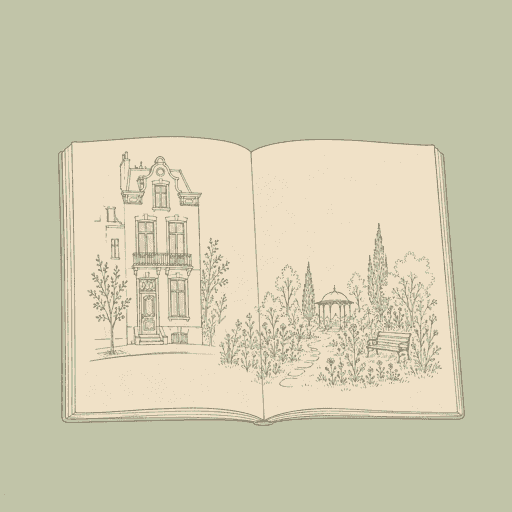
33 Place Brugmann
A modern alternative to SparkNotes and CliffsNotes, SuperSummary offers high-quality Study Guides with detailed chapter summaries and analysis of major themes, characters, and more.
Summaries & Analyses
Quizzes
NEWReading Tools
Symbols & Motifs
The Building at 33 Place Brugmann
The apartment building at 33 Place Brugmann is a complex symbol, functioning as a microcosm of Belgian society trapped under the pressures of occupation. More than just a setting, the building is an active participant in the narrative, its physical structure dictating the moral landscape for its residents. The novel opens with the declaration, “We hear every sound in this building” (3), establishing from the outset that privacy is an illusion and that no action can be isolated from its neighbors. This forced intimacy transforms the building into a moral crucible where the lives of collaborators like the notary Jan Everard, resisters like Colonel Warlemont, and victims like the Raphaëls are inextricably linked.
The thin walls and shared staircases become conduits for both lifesaving information and fatal betrayals. Miss Hobert’s eavesdropping and Dirk’s silent observations demonstrate how proximity enables The Cost of Passive Complicity, turning quiet self-interest into a weapon. Though Charlotte initially sees the building as a “fortress that’s impervious to anything beyond” (10), the narrative systematically proves this false. The true conflict is internal, waged within the walls, where personal choices ripple through the interconnected lives of the residents, making 33 Place Brugmann a powerful symbol of a nation’s soul under siege.
Wittgenstein’s Tractatus Logico-Philosophicus
The recurring motif of Ludwig Wittgenstein’s Tractatus Logico-Philosophicus represents the search for a rational order and a system of meaning in a world where logic has collapsed. Shared among the novel’s intellectual male characters, namely Francois, Julian, and Philippe, the book and its aphorisms provide a framework for confronting the chaos of war. For them, its precise, logical propositions about facts, pictures, and the limits of language are a tool for trying to make sense of the senseless.
However, the novel simultaneously critiques this reliance on pure logic, illustrating The Limits of Objective Truth. Charlotte, who sees the world differently due to her colorblindness, initially dismisses the book, embodying a form of truth derived from intuition and subjective experience rather than philosophical propositions. Yet, by the end, even she turns to it, suggesting a universal need for structure in the face of absolute loss. Francois’s final sketchbook entry, quoting the book’s preface, “What is thinkable is also possible” (342), transforms Wittgenstein’s logical premise into an act of creative defiance and hope. The book thus becomes a powerful, albeit ultimately inadequate, symbol of humanity’s attempt to impose a coherent “picture” on the fractured, illogical reality of war.
The Lioness
The lioness is the novel’s most powerful and enigmatic symbol, representing a mystical, protective, and distinctly feminine force that exists beyond the rational world of the occupation. Her appearances to Masha and Charlotte coincide with moments of deep insight or crisis, offering a vision of an alternate, more powerful reality.
Masha first sees the lioness after a night with Harry, at a moment when she feels she is seeing the world through Charlotte’s colorless eyes, as a “flaxen creature” in the square. This links the lioness to a different way of perceiving reality, one that transcends the ordinary. For Charlotte, the lioness evolves from a fleeting vision into a tangible presence, a spiritual guardian she invites into her home after her father is taken away. This act signifies Charlotte’s acceptance of a power based on intuition and the “inexpressible.” In a narrative structured around the intellectual framework of Wittgenstein’s Tractatus, the lioness embodies the very thing the book admits it cannot articulate: the mystical. She shows a form of truth that is spiritual, wild, and defiant, offering a potent counterbalance to the patriarchal violence of war and illustrating the limits of objective truth.

Unlock the meaning behind every key symbol & motif
See how recurring imagery, objects, and ideas shape the narrative.
- Explore how the author builds meaning through symbolism
- Understand what symbols & motifs represent in the text
- Connect recurring ideas to themes, characters, and events