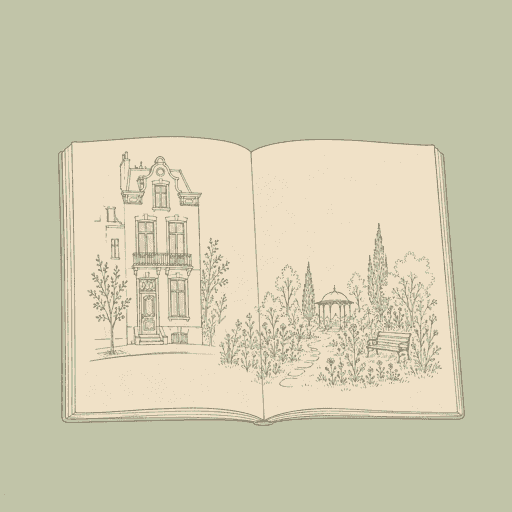
33 Place Brugmann
A modern alternative to SparkNotes and CliffsNotes, SuperSummary offers high-quality Study Guides with detailed chapter summaries and analysis of major themes, characters, and more.
Summaries & Analyses
Quizzes
NEWReading Tools
Themes
Content Warning: This section of the guide includes discussion of religious discrimination and death.
The Cost of Passive Complicity
In 33 Place Brugmann, Alice Austen dismantles the notion that passivity during wartime is a neutral stance. The novel argues that even minor acts of self-interest and quiet cooperation with an occupying force are essential components that enable systemic atrocity. Through the residents of a single Brussels apartment building and their acquaintances, the narrative reveals how small, individual choices, like profiting from a neighbor’s misfortune, enforcing petty rules, or trading information for favor, collectively build the infrastructure of persecution. The story demonstrates that in a time of moral crisis, there is no middle ground; every action either resists or enables the encroaching darkness.
The most common form of complicity is economic opportunism, which corrodes the bonds of community. Smets, the local grocer, consistently attempts to short Charlotte Sauvin on her rations and shows deference to Nazi officers, prioritizing his own small gains over his lifelong neighbors. His maliciousness illustrates how the occupation empowers petty tyrants to weaponize their minor authority. A more sophisticated version of this opportunism is seen in the art dealer Mats, who tries to exploit Leo Raphaël’s precarious position as a Jewish dealer by offering to “front” his business. Mats presents his proposal as a realistic adaptation to the times, but Leo recognizes it as a predatory attempt to profit from antisemitic policies. Both Smets and Mats choose personal advantage over loyalty and decency, their actions serving as microcosms of the broader societal breakdown, where self-interest becomes a quiet form of collaboration.
Beyond financial gain, the novel explores how the manipulation of information becomes a critical tool of oppression. Miss Hobert cloaks her invasive curiosity in the language of truth and order. Her tendency to eavesdrop and report “irregularities,” such as hearing voices in Colonel Warlemont’s apartment, directly leads to Gestapo searches and places her neighbors in mortal danger. Though she may not see herself as a Nazi sympathizer, her actions make her an agent for the regime. Similarly, the building’s notary, Jan Everard, receives a “Christmas bonus” for informing the authorities about the potential hidden value of the Raphaëls’ empty apartment. His betrayal is a calculated transaction, trading his knowledge of his former neighbors for financial reward. In both cases, information is a currency used to purchase security or advantage at the expense of others, demonstrating how easily personal grievances and greed can be co-opted by a totalitarian state.
Ultimately, these isolated acts of complicity are shown to be interconnected, forming a web that supports the occupation. The grocer who favors a soldier, the informant who reports a neighbor, and the professional who exploits a colleague all contribute to an environment where persecution can flourish. The novel powerfully argues that the great evils of history are facilitated by the countless ordinary people who choose to look away or, worse, to quietly benefit from the suffering of others.
Art as a Repository of Humanity
Amidst the brutal destruction and dehumanizing pressures of the Nazi occupation, 33 Place Brugmann posits that the creation and preservation of art are essential acts of resistance. Art functions as an essential repository of cultural memory, individual soul, and the very idea of a humane world. For the characters, a dedication to painting, architecture, or even the craft of hat-making becomes a way to defy the soulless, utilitarian logic of the regime. By safeguarding or creating objects of beauty and meaning, they protect a part of themselves and the civilization that the war threatens to obliterate.
The most significant act of preservation is the effort to save the Raphaël family’s art collection. This mission operates on two levels: Leo Raphaël’s work with the international art community to hide masterpieces in a Welsh quarry, and the more intimate conspiracy to hide his own family’s paintings under the floorboards of Francois Sauvin’s apartment. In both cases, art is treated as something as precious as life itself. The paintings are touchstones of memory, family history, and a world of ideas. Leo refers to the public display of a single painting in war-torn London as a reminder of “the big idea” of “who we are. As people” (191). This sentiment emphasizes the belief that art embodies a collective human spirit that must be protected at all costs, serving as a tangible link to a past and a potential future where beauty and creativity matter.
While preservation looks to the past, the act of creation becomes a powerful assertion of hope for the future. After his architecture firm is shut down by the Nazis, Francois Sauvin retreats into his sketchbook. There, he designs fantastical, life-affirming buildings with no straight lines, like structured gardens full of light and spaces for human connection. This private work is a form of spiritual and intellectual resistance against the rigid, oppressive aesthetic of the occupiers. His drawings are an act of worldbuilding, proof of his belief that “[w]hat is thinkable is also possible” (342). Similarly, his daughter Charlotte finds refuge and purpose in making hats. Creating a perfectly crafted hat for the bitter Miss Hobert is a small but meaningful act of imposing order and beauty on a chaotic world. Her final resolve to paint again, even after her father’s death, signals that the creative impulse is a fundamental response to loss and a way to rebuild a world of meaning.
Ultimately, the novel portrays art as the carrier of the “inexpressible,” the part of the human experience that cannot be quantified, controlled, or extinguished by a totalitarian regime. The characters’ relationship with art is what keeps their inner lives intact. Whether hiding a Monet, sketching an impossible building, or shaping a piece of felt, they are engaged in the sacred work of keeping the human soul alive.
The Limits of Objective Truth
33 Place Brugmann uses the philosophical inquiries of Ludwig Wittgenstein as a framework to question the existence of a single, objective truth. The novel argues that “the totality of facts” is insufficient to capture the complexity of human experience (242), which is deeply shaped by subjective perception, emotional reality, and the failures of language. Through characters who perceive the world in radically different ways and a plot driven by secrets and misinterpretations, the narrative demonstrates that truth is a fluid, personal, and often dangerous concept. The story suggests that what is felt and experienced can be more real than what can be factually proven.
The recurring references to Wittgenstein’s Tractatus Logico-Philosophicus establish the novel’s central philosophical tension. Julian, Francois, and Philippe are all drawn to the book’s attempt to create a logical structure for the world, a system where facts correspond to reality. However, the chaos of war continually undermines this ideal. The character who most embodies the novel’s counterargument is Charlotte. Her colorblindness is a literal representation of subjective reality; she perceives the world differently but no less truthfully than others. Her vision is the source of her artistic gift, allowing her to create stunning and unusual color combinations. Her reality, based on light, form, and tone rather than pigment, is complete and valid, challenging the very idea that there is one “correct” way to see the world.
Furthermore, the novel illustrates how easily “truth” can be manipulated, misinterpreted, or weaponized. Miss Hobert’s obsession with reporting the “truth” as she hears it through the walls is a destructive force, as her partial, context-free information leads directly to Gestapo action. Her truth is a weapon born of loneliness and a need for control. Dirk DeBaerre, the silent observer, constructs his own version of reality based on what he sees, but his interpretations are filtered through a lens of deep-seated resentment and psychological complexity. His ultimate decision to help Julian is based on an old, subjective debt signified by a red pencil, an emotional truth that overrides any objective assessment of the situation. These characters show that what people choose to believe or report as fact is often a reflection of their own inner state rather than an objective account of events.
The ultimate ambiguity surrounding Masha Balyayeva’s death serves as the novel’s most moving example of truth’s limits. The only account of her final moments comes from Harry, the man who killed her. His claim that he shot her as an act of mercy to prevent her capture and torture is a subjective truth that can never be verified. Whether it was a necessary evil, a selfish act of self-preservation, or something else entirely remains unknowable. The objective facts of her death are lost, leaving only a painful, unresolved story. In this way, the novel suggests that the gravest realities of love, betrayal, and sacrifice exist in the inexpressible space beyond verifiable facts.

Unlock every key theme and why it matters
Get in-depth breakdowns of the book’s main ideas and how they connect and evolve.
- Explore how themes develop throughout the text
- Connect themes to characters, events, and symbols
- Support essays and discussions with thematic evidence