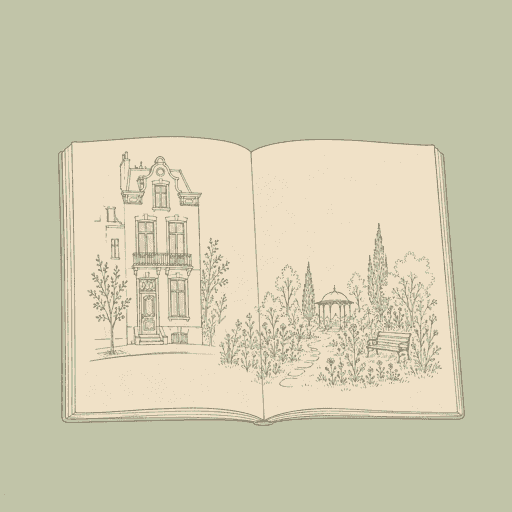
33 Place Brugmann
A modern alternative to SparkNotes and CliffsNotes, SuperSummary offers high-quality Study Guides with detailed chapter summaries and analysis of major themes, characters, and more.
Summaries & Analyses
Quizzes
NEWReading Tools
Part 2, Chapters 10-18Chapter Summaries & Analyses
Content Warning: This section of the guide includes discussion of religious discrimination, sexual harassment, illness, emotional abuse, ableism, bullying, and death by suicide.
Part 2: “After”
Part 2, Chapter 10 Summary: “Charlotte Sauvin, 4L”
The novel jumps forward to May 1940, as the German occupation of Brussels begins. Charlotte’s husband, Philippe, leaves to join the fight against the Nazis. The constraints of the occupation tighten gradually over the following months. Six months after Philippe leaves, the hat shop where Charlotte works is forced to close because its Jewish owner can no longer operate. While waiting for a tram after her last day, Charlotte must stand by as a parade of well-fed Nazi soldiers marches past.
Later, at a grocery store, the proprietor, a man named Smets, attempts to short Charlotte on her butter ration. A German officer named Schmidt, who has a polite demeanor, steps in. While making his own purchase, he discreetly slips an extra packet of butter into Charlotte’s bag as he passes her. At the bakery, the owner, a woman named Maryanne, gives Charlotte a loaf of bread made with better flour than her ration ticket allows. On her way home, Charlotte impulsively slips the extra butter into the hand of a young newsboy who sells the collaborationist paper Le Soir but also secretly distributes a resistance paper. Charlotte, who has been married for less than a year and has not heard from Philippe in a month, struggles to recall the specific details of his face and presence.
Part 2, Chapter 11 Summary: “Colonel Warlemont, 3L”
Colonel Warlemont’s dog, Zipper, becomes ill after eating an entire cake given to them by their neighbor, Miss Hobert. Shortly after, the Colonel receives an unexpected visit from his old friend Harry. Harry reveals that he has married Masha and they are now living in Paris. He explains that Masha works as a seamstress for the wives of powerful men in Paris, allowing Harry to gather intelligence from what she overhears.
Harry asks the Colonel to join a resistance network he is building to help people escape occupied territory. He mentions he plans to eventually send Masha to safety at a farm through this network. The Colonel, knowing Harry has a history of poor judgment when it comes to trusting people, is hesitant. He agrees to think about the proposition, and Harry tells him he will return in a month for an answer.
Part 2, Chapter 12 Summary: “Leo Raphaël, 4R”
Leo is on a train in the United Kingdom, concealing from his wife, Sophia, that their son Julian has joined the military. He reflects on Wittgenstein’s Tractatus, disagreeing with its premise and arguing that reality aspires to the ideal of art, not the other way around. He also has a vivid dream-like vision in which he is one of the Turks who have captured Athens and are gutting the Parthenon’s columns for lead. In the vision, the Greeks give the Turks bullets in exchange for a promise to stop destroying the monument.
Leo is overseeing a secret project to move a museum’s art collection into a slate quarry in Wales for safekeeping. The move was prompted after a drunken baron, in whose castle some paintings were stored, had a collision with one of his dogs that nearly ripped a hole in a priceless canvas. While touring the mine, Leo has a vision of his friend, the painter Paul Delvaux, filling the quarry with images of skeletons. He recalls a past conversation with Charlotte about a Delvaux painting, in which she perceptively noted that two figures in different planes of the painting were the same person. Troubled by his increasing difficulty in separating dreams from waking life, Leo finds comfort in the memory of this logical conversation.
Part 2, Chapter 13 Summary: “Julian Raphaël, 4R”
Julian is serving as a navigator in the Royal Air Force. He is aware of the grim odds of survival for flight crews but conceals this information from his fellow airmen, a group that includes a man named Blake. Instead, he boosts their morale by telling them their crew is exceptionally skilled and therefore has a better chance.
An intelligence officer summons Julian to identify a man whose face has been surgically altered for a disguise. Julian is shocked to recognize the man as his childhood friend, Guy, who is now an operative for the Special Operations Executive (SOE), the British espionage agency. Guy explains that he was captured by the Nazis and bonded with a sympathetic guard over Stendhal’s novel The Red and the Black; when a second guard identified Guy as Jewish by his nose, the first guard risked his life to help Guy escape. During the escape, a bullet struck the copy of the book he was carrying, saving his life.
Recalling the incident, Julian remembers a childhood dare where Guy fearlessly climbed along the narrow exterior ledge of their apartment building, using a knife to carve handholds in the mortar. Julian realizes Guy’s daring and observant nature makes him perfectly suited for espionage.
Part 2, Chapter 14 Summary: “City of Brussels”
A German Military Authority Ordinance dated May 29, 1942, is posted publicly in Brussels. The notice declares that wearing a Yellow Star is now mandatory for all Jews aged six and older. It also requires all Jews to register with the authorities and mandates that Jewish-owned businesses, such as hotels and restaurants, must also register and post identifying notices.
Part 2, Chapter 15 Summary: “Francois Sauvin, 4L”
In the wake of the new ordinance, Francois Sauvin informs the architects at his firm that he will not enforce the rule requiring their Jewish members to wear yellow stars. The firm includes two Jewish men, David and Albert, and two Catholics, Jean and Christophe. David argues they must comply to feed their families, while Albert suggests they go underground. Christophe argues for compliance and states he would be more comfortable if the Jewish architects left. In response, Francois fires Christophe. David ultimately leaves without a word. A week later, the authorities shut down the firm for noncompliance with new building codes.
Francois’s neighbor, a lawyer named Martin DeBaerre, reveals he is secretly supporting a Jewish family in hiding and entrusts Francois with a sealed envelope, instructing him to deliver it to Maryanne the baker if anything should happen to him. Martin expresses frustration with his son, Dirk, who preaches riding the wave of history yet lives idly off his father. Soon after, Francois becomes tormented by a persistent phantom smell of rot and decay. He recalls telling a young Charlotte a story about a beautiful painting that outlasts the people who created it.
Part 2, Chapter 16 Summary: “Charlotte Sauvin, 4L”
In November 1942, Charlotte sees her factory manager, Mr. DeDecker, confiscating loaves of bread from a woman on the street without payment. Later, in his office, DeDecker reveals he knows Charlotte’s father is unemployed and propositions her, threatening to have her conscripted for forced labor in Germany if she refuses. Charlotte lies, claiming she is pregnant with a soldier’s child; she immediately second-guesses herself for having said “officer,” worrying that Philippe’s French nationality could expose the lie. When DeDecker touches her stomach, she involuntarily vomits on him. She uses his revulsion and her threat to report him to quit her job immediately. Later, she acknowledges her pregnancy to herself and realizes that Philippe has no idea that he will soon be a father.
Charlotte’s coworker, Beatrice, tells her that DeDecker is both cheating on his wife and stealing from the VNV, the Flemish collaborationist party. To help expose him, Charlotte gives Beatrice the address of DeDecker’s lover. Later, the newsboy gives Charlotte a secret message confirming that Philippe is alive and at a parachute training school in England, likely Ringway.
Part 2, Chapter 17 Summary: “Dirk Debaerre, 2R”
Dirk DeBaerre’s father, Martin, is arrested because he was discovered to be hiding a Jewish family. To mislead his nosy neighbor Miss Hobert and avoid the shame of their association, Dirk implies his father was arrested over an affair with a man. He recalls a childhood incident where he maliciously swapped his cheap pencils for Charlotte’s high-quality set. Because Charlotte has colorblindness, she was punished by a nun for using the wrong color, which led to her being bullied by classmates.
After his father’s arrest, Dirk’s mother accidentally lets slip that Martin was not his biological father, revealing that he had already been born when she and Martin were married. Days later, when he persists in learning the true identity of his biological father, she laughs and points to her stepfather’s desk, revealing that Dirk’s real father was her own stepfather. Shortly after this revelation, she steps in front of a tram. At the hospital, a doctor informs Dirk that her injuries are fatal. Dirk instructs the doctor not to operate and sits with his mother until she dies. Afterward, he asks the doctor to officially record her death as an accident and then invites him out for coffee.
Part 2, Chapter 18 Summary: “Masha Balyayeva, 5th Floor”
Masha is living in Paris with Harry. She poses as a Russian refugee who fled the Bolsheviks and works as a dressmaker for the wives and lovers of high-ranking Nazi-collaborating officials. This position allows her to gather intelligence, which she passes to Harry. She becomes more directly involved in his resistance work when she is asked to escort a clarinet player, Alex Vive, to the next link in an escape chain.
Harry grows increasingly tense and prone to angry outbursts. He frequently makes promises by swearing on his mother’s life and tells Masha he will send her to a safe farm in England if the situation in Paris becomes too dangerous. Masha later learns that Harry’s mother had in fact died during the previous war, 20 years before they met. Masha begins to suspect that Harry may be involved with another woman and threatens to leave for England if she discovers this to be true. Despite this, Masha reflects that her love for Harry remains unchanged.
Part 2, Chapters 10-18 Analysis
Charlotte Sauvin’s daily errands under the occupation illustrate how the war’s moral conflicts are waged in miniature through everyday transactions. At the grocery, the proprietor Smets weaponizes his position to cheat her on her butter ration, a petty act of malice that reflects the broader societal rot of the occupation. In contrast, the baker Maryanne defies rationing rules to give Charlotte a better loaf of bread, while the German officer Schmidt performs an unexpected act of kindness by secretly supplementing Charlotte’s purchase. These moments demonstrate how the occupation creates a landscape of constant moral negotiation, where small choices reveal character. This dynamic highlights the theme of The Cost of Passive Complicity; Smets’s opportunism and the factory manager DeDecker’s predatory behavior empower the regime through countless minor capitulations. Conversely, Maryanne’s generosity and Charlotte’s subsequent decision to give the extra butter to the resistance newsboy represent small, essential acts of solidarity that form the foundation of organized opposition. The German officer’s gesture further complicates the narrative, suggesting that humanity can surface in unlikely places, defying the clear-cut allegiances of war.
Beyond Charlotte’s experiences, the other characters’ reactions to the social changes enforced by the occupation reveal the ethical systems affecting the larger community that 33 Place Brugmann represents. The implementation of the discriminatory German ordinance requiring Jewish people to wear a yellow star forces latent moral alignments to the surface and fractures communities. The edict shatters the professional camaraderie of Francois Sauvin’s architectural firm, as his employees are forced to choose between complicity, defiance, and self-preservation. Christophe’s call to expel his Jewish colleagues reveals a dormant antisemitism, while Albert’s decision to go underground and David’s pained departure show the impossible choices faced by those targeted. This fracturing of a professional unit mirrors the wider societal breakdown. In contrast, the ordinance also forges new bonds of conscience. Martin DeBaerre reveals his secret work supporting a Jewish family and entrusts his life to Francois, creating a clandestine alliance of resistance within the symbol of the building at 33 Place Brugmann. These divergent responses demonstrate that while the regime’s policies are designed to isolate and dehumanize, they also galvanize principled opposition, forcing individuals to define themselves through action.
As Belgian society descends into chaos, Leo Raphaël’s mission to save a museum’s art collection drives the theme of Art as a Repository of Humanity. His project to create an “underground museum” in a Welsh slate quarry, an endeavor based on the historical Manod Quarry evacuation, frames the preservation of culture as a critical form of resistance. On a train, Leo internally debates Wittgenstein’s philosophy, rejecting the idea that language merely pictures reality and arguing instead that “[r]eality aspires to the picture, the ideal” (122). This represents a complete reversal of Wittgenstein’s position, which the novel will continue to assert in various forms. For Leo, paintings and artworks are the embodiment of civilization’s highest ideals, a tangible legacy that must be protected from the “catastrophe” of war. This belief is allegorized in his dream of the ancient Greeks, who choose to give their enemies bullets rather than allow them to dismantle the Parthenon, recognizing that the survival of the monument, which is the physical manifestation of their culture, is more important than a short-term military outcome. Leo’s struggle to distinguish these powerful dreams from his waking life emphasizes the immense psychological strain of his work, as he fights to safeguard tangible ideals in a world that feels increasingly unreal.
The necessities of espionage and resistance force several characters to adopt new identities, exploring the instability of selfhood in wartime. Julian’s childhood friend, Guy, reappears as a Special Operations Executive agent with a surgically altered face, a literal transformation that makes him unrecognizable even to his oldest friend. His survival story, in which he escapes capture thanks to a sympathetic German guard and he survives because his copy of Stendhal’s writing stops a bullet, illustrates a world of radical contingency where literature and unlikely human connections can rewrite one’s fate. In Paris, Masha Balyayeva performs a carefully constructed identity as a White Russian refugee, using her position as a seamstress to the collaborationist elite to gather intelligence. These acts of deception are necessary for survival and resistance, reflecting a world where The Limits of Objective Truth become apparent; constructed narratives and false identities become more potent tools than verifiable facts. Harry’s habit of swearing on the life of his long-dead mother reveals that even personal relationships can be built on fictions, suggesting that deception becomes an inescapable condition of a life defined by trauma and subterfuge.
In contrast to these characters who disguise the truth in order to embody their deepest principles, Dirk DeBaerre’s narrative offers a chilling case study of the moral nihilism that flourishes under an oppressive regime. His childhood cruelty toward Charlotte, in which he deliberately swaps her pencils to weaponize her colorblindness and subject her to ridicule, establishes a foundational capacity for calculated malice. This act is a precise exploitation of a hidden vulnerability, revealing an early fascination with manipulation and power. This pathology matures into a worldview of detached self-interest. He rationalizes inaction by claiming to “ride” the “wave of history” (151), a philosophy that absolves him of responsibility and allows him to watch impassively as his father is arrested for an act of conscience. After this leads to his mother’s attempt to die by suicide, Dirk’s decision to withhold life-saving surgery for her represents his final detachment from empathy. He embodies the human consequence of the societal rot that Francois perceives as a phantom smell, a person who thrives in a morally bankrupt system by shedding all human connection.

Get in-depth, chapter-by-chapter summaries and analysis from our literary experts.
- Grasp challenging concepts with clear, comprehensive explanations
- Revisit key plot points and ideas without rereading the book
- Share impressive insights in classes and book clubs